

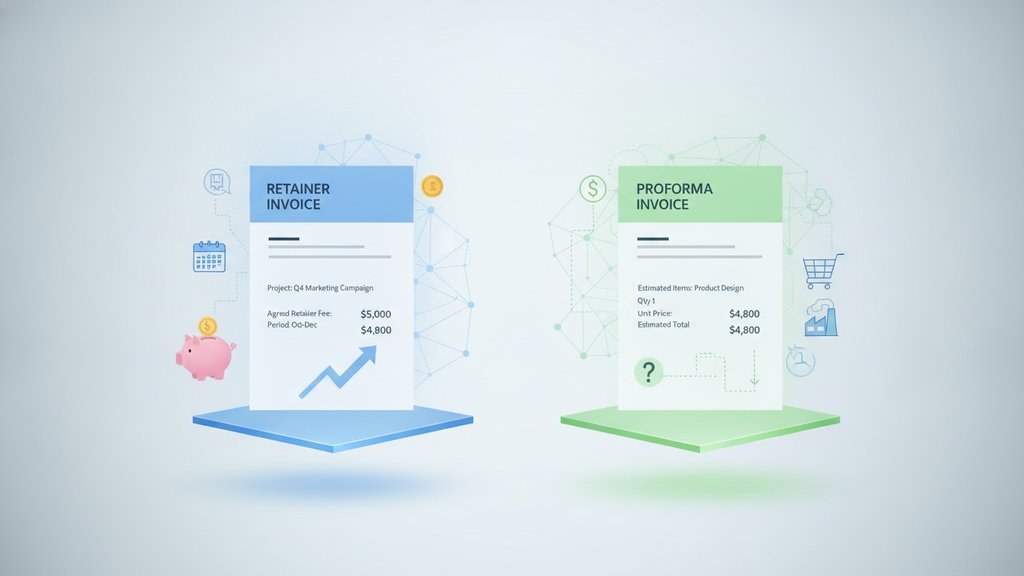
A retainer invoice is a bill you send a client to collect payment before work begins, usually to secure your availability or fund an ongoing engagement. Unlike a proforma invoice (which is a preliminary quote showing what a future sale will cost), a retainer invoice actually requests real money upfront, often held as a credit balance that you draw down as you deliver work. So a proforma says "here's what you'll owe," while a retainer invoice says "pay this now to reserve my time."
Content Table
What a retainer invoice actually is
A retainer invoice requests an advance payment from a client, either as a fixed recurring fee or a lump sum you hold against future work. It's common in fields where you commit time before you know exactly how much you'll use it: law firms, consultants, agencies, freelance designers, and accountants all use it.
There are two flavors you'll run into:
- Pay-for-access retainer: The client pays a flat monthly fee to guarantee your availability, whether or not they use all of it. Think of a lawyer "on retainer" who answers calls whenever needed.
- Prepaid-work retainer: The client deposits money that sits as a credit balance. You bill against it as you complete hours or deliverables, and top it back up when it runs low.
The key detail: money changes hands before the work is fully done. That's what separates retainer billing from a standard invoice, which you send after delivery.
How retainer billing works step by step
Here's the typical flow for a prepaid-work retainer:
- Agree on the retainer amount in a signed contract (say, $3,000 covering roughly 20 hours of work).
- Send the retainer invoice requesting that $3,000 upfront.
- Client pays, and you record the money as a liability (it's their credit, not your earned revenue yet).
- Track work against the balance. After 8 hours, you've "used" $1,200, leaving $1,800.
- Send a statement or drawdown invoice showing what was consumed and what remains.
- Replenish when the balance hits a threshold, or reconcile at the end of the engagement.
Retainer invoice vs proforma invoice
People mix these up because both come before a normal invoice, but they do completely different jobs. A proforma invoice is essentially a detailed quote formatted like an invoice. It tells the buyer what a purchase will cost so they can approve it, arrange financing, or clear customs. It is not a demand for payment and it doesn't create an accounting entry.
| Feature | Retainer Invoice | Proforma Invoice |
|---|---|---|
| Purpose | Collect advance payment to reserve work | Preview the cost of a future sale |
| Requests real money? | Yes, immediately | No, it's a quote |
| Legally binding demand? | Yes, per the contract | No |
| Accounting entry? | Recorded as a liability/deposit | None until a real invoice is issued |
| Typical use | Ongoing services, consulting | International shipping, pre-sale approval |
If you're deciding which document fits your situation, our guide on the proforma invoice format and when to use one walks through the exact fields a proforma needs. And if you're weighing a quote against a bill more generally, the breakdown of when to send an estimate vs an invoice covers that decision too.
What to include on a retainer invoice
A retainer invoice looks similar to a regular invoice, but it makes the advance nature obvious. Include:
- A clear label such as "Retainer Invoice" or "Advance Payment" so nobody mistakes it for a final bill.
- Your business and client details , invoice number, and date.
- A single line item describing the retainer (for example, "Monthly retainer, June 2026" or "Advance deposit against project X").
- The amount and any applicable tax. Depending on your country, VAT or sales tax may apply at the time of the deposit.
- Payment terms : due date, accepted methods, and what the retainer covers.
- A note explaining how the balance will be drawn down or credited against future work.
Because the description matters so much here, it's worth getting the wording right. Our tips on writing clear invoice line items help you phrase the retainer so both sides know exactly what's covered.
Writing a retainer fee clause
The invoice only works if it's backed by a contract. A retainer fee clause sets the rules so there's no argument later. A solid clause spells out:
- The retainer amount and how often it's charged (one-time, monthly, quarterly).
- What the fee buys: a set number of hours, priority access, or a scope of deliverables.
- Whether it's refundable. Unused pay-for-access retainers are often non-refundable; unused prepaid balances usually are.
- Rollover rules: do unused hours carry into next month, or expire?
- Rates for work beyond the retainer, so overages are handled cleanly.
How tax and accounting handle retainers
This is where retainers trip people up. When you receive a retainer, the cash is in your bank, but it usually isn't earned revenue yet. Standard accrual accounting treats it as a liability (often called "deferred revenue" or "customer deposits") until you actually perform the work.
As you deliver, you move portions from the liability into earned revenue. Tax authorities like the IRS in Publication 538 and the UK's HMRC VAT guidance have specific rules on when advance payments become taxable, and in many VAT systems tax is due at the point the deposit is received, not when the work finishes.
Because a retainer invoice for a service often needs to double as a valid tax document, it helps to know what makes a tax invoice different from a regular invoice so your retainer invoice satisfies both jobs at once.

Create a retainer invoice in minutes, free
Label the document, add your retainer line item and payment terms, apply tax, and download a clean PDF. No sign-up needed to build a professional retainer invoice.
Create your retainer invoice →
They overlap. A deposit invoice usually secures a single project (like part of a build cost), while a retainer invoice often funds ongoing access or a rolling balance of hours. Both collect money upfront and are recorded as a liability until you earn the revenue by delivering work.
It depends on your retainer fee clause. Prepaid-work retainers usually refund any unused balance when the engagement ends. Pay-for-access retainers, where a client pays for your availability, are often non-refundable even if they don't use your time. Always state the rule in the contract.
Often yes. In many VAT systems, tax becomes due when you receive the advance payment, not when the work is completed. In some sales-tax jurisdictions it applies later. Because rules differ by country and service type, confirm the correct treatment with a local accountant.
Only if you're previewing a cost, not requesting payment. A proforma is a formal quote with no accounting entry and no binding demand. If you need the client to actually pay to reserve your time, you need a retainer invoice backed by a signed retainer clause.
Send a periodic statement or drawdown invoice listing the opening balance, hours or deliverables consumed with dates, the value used, and the remaining credit. This keeps the client informed and makes replenishment requests easy to justify when the balance runs low.