
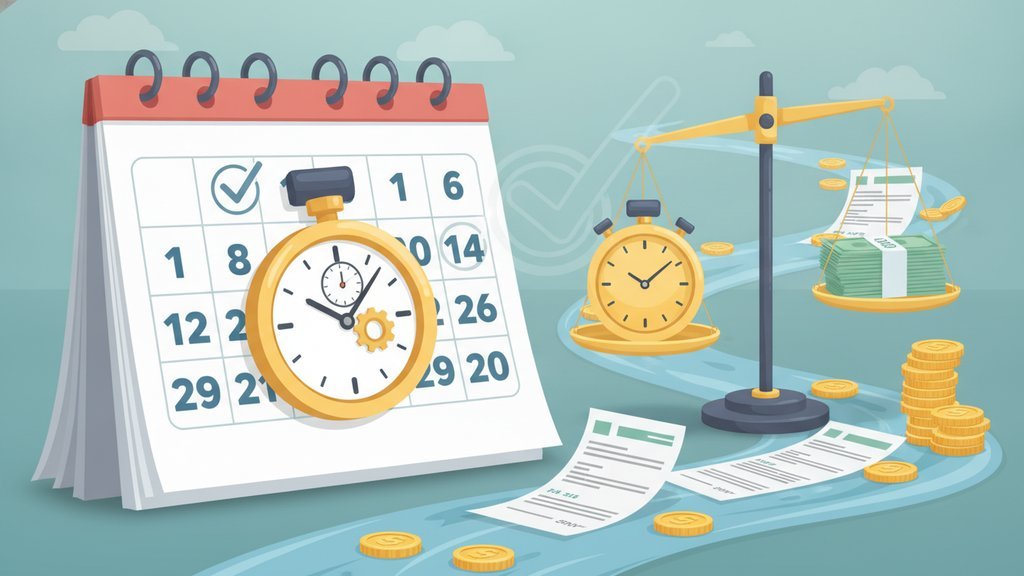
Most invoices should be due within 14 to 30 days of the invoice date, with "Net 30" being the standard default for business-to-business work. But the right invoice due date depends on your industry, your relationship with the client, and how badly you need the cash. A freelancer working with a small local shop might ask for payment in 7 days, while a supplier dealing with a large corporation may be pushed toward Net 60 whether they like it or not.
Content Table
Most invoices use Net 15 or Net 30, and some are due on receipt. For how each term works and which one to offer, see our guide to payment terms.
How to choose a realistic due date
The "when should an invoice be due" question really comes down to balancing your cash needs against what the client will actually accept. Push too hard and you look unreasonable; give too much slack and you're financing their business for free. A few things to weigh:
- Your cash flow. If you pay contractors or buy materials up front, you can't afford to wait 60 days. Shorter terms protect you.
- The client's size and habits. Big companies run on rigid accounts-payable cycles. Asking a corporation for Net 7 usually gets ignored, not respected.
- Industry norms. Construction and manufacturing lean toward Net 30 to Net 90. Creative and consulting work often uses Net 14 to Net 30.
- The relationship. A brand-new client is riskier, so shorter terms (or a deposit) make sense. A trusted repeat client has earned some flexibility.
- Invoice size. A $200 invoice can reasonably be due on receipt. A $40,000 invoice almost always needs a longer window.
Setting a clear deadline also protects you later. If the date passes and nothing arrives, you have a firm reference point for follow-up. It helps to understand exactly when an invoice officially becomes overdue so your reminders and any late fees are grounded in the terms you actually wrote.
How to calculate the actual due date
Payment term calculation is simple once you know the start point. The clock almost always starts on the invoice date, not the day the work finished or the day the client opened the email. To find the due date:
- Take the invoice date printed on the document.
- Add the number of days in your term (7, 14, 30, and so on).
- Write that final calendar date directly on the invoice as the payment deadline.
Example: an invoice dated April 3 with Net 30 terms is due on May 3. Some businesses count "end of month plus 30," which would push a April invoice to end of May. Decide which method you use and keep it consistent so clients aren't guessing about your invoice expiration date.
One point worth clearing up: an invoice has no expiry, the due date is simply the deadline for paying it. Quotes and estimates are the documents that expire, which is why they usually carry a validity date.
When you send the invoice matters just as much as the deadline you set. Firing it off promptly after the work is done keeps the whole cycle tight, and there's real strategy to the timing of when you send an invoice.
When immediate payment terms make sense
"Due on receipt" and other immediate payment terms aren't rude, they're just right for certain situations:
- First-time clients you haven't built trust with yet.
- Small, quick jobs where a 30-day wait isn't worth the paperwork.
- Retail or point-of-sale style work, where payment naturally happens on the spot.
- Clients with a history of paying late, where you want the cash locked in fast.
For larger projects, a full up-front payment can feel like a lot to ask. That's where a deposit plus a final balance works nicely. Splitting a bill into stages, using partial payments across multiple invoices, gives the client breathing room while still protecting your cash flow. Note that an estimate is not the same as a bill, so if you're quoting future work, make sure you understand the difference between an estimate and an invoice before you set any deadline.
Make the due date impossible to miss
A deadline only works if the client can see it without hunting for it. Two habits do most of that work:
- Write the exact calendar date. "Payment due by March 15" is clearer than "Net 30" on its own. Put that date in bold near the total instead of in the fine print.
- Send a reminder before the date, not after. A short note a few days ahead reads as a courtesy, and it catches invoices sitting unopened in an inbox while there is still time to pay on time.
Keep copies of everything, too. Once an invoice is paid you still need the record for tax and accounting, and there are rules about how long you should keep invoices that vary by country.
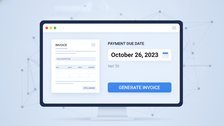
Set clear invoice due dates in seconds
Our free invoice generator lets you add Net 30, due-on-receipt, or any custom payment deadline and prints the exact due date right on the invoice, in over 20 languages.
Create an invoice →
Most businesses treat the next working day as the deadline, since bank transfers don't settle on weekends or public holidays. The term itself doesn't say that, so if it matters to you, spell it out on the invoice: "If the due date falls on a weekend or public holiday, payment is due the following business day."
In almost all cases the clock starts on the invoice date printed on the document, not when the work was finished or when the client opened the email. To calculate the deadline, add your term length (7, 14, or 30 days) to the invoice date and write that final calendar date on the invoice.
Not at all. "Due on receipt" is perfectly professional for small jobs, first-time clients, or anyone with a history of paying late. For bigger projects, a deposit plus a final balance is a friendlier alternative that still protects your cash flow without demanding the full amount up front.