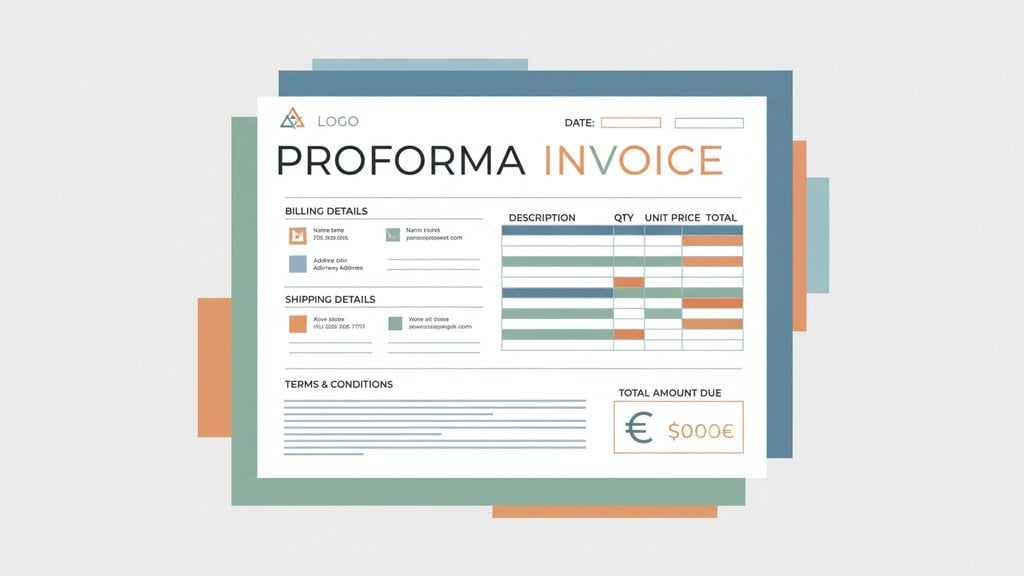
A proforma invoice format is a preliminary document sent to a buyer before a sale is finalized, outlining what goods or services will be provided, at what price, and under what terms. Think of it as a formal quote dressed up to look like a real invoice - it gives the buyer everything they need to approve a purchase, arrange payment, or clear customs, without creating an actual financial obligation yet. Knowing exactly what to include (and when to send one instead of a regular invoice) saves you from confusion, delays, and compliance headaches.
Content Table
What Is a Proforma Invoice?
The term "proforma" comes from Latin meaning "as a matter of form." A proforma invoice is essentially a declaration of intent - a seller tells the buyer: "Here is what I plan to sell you, at this price, on these terms." It looks almost identical to a real invoice, but it carries one critical distinction: it is not a demand for payment and does not get recorded as accounts receivable in your books.
Proforma invoices are recognized internationally. The World Customs Organization's Revised Kyoto Convention acknowledges them as acceptable supporting documents for customs declarations, which is why they are so common in international trade.
Proforma vs Invoice - Key Differences
People often confuse the two because they share the same layout. Here is where they actually differ:
| Feature | Proforma Invoice | Commercial Invoice |
|---|---|---|
| Legal obligation | None - buyer can decline | Binding payment demand |
| Recorded in accounts | No | Yes (accounts receivable) |
| VAT / tax treatment | Not a taxable event | Triggers VAT liability |
| Customs use | Accepted for pre-shipment clearance | Required after shipment |
| Timing | Before goods are delivered | After delivery or at point of sale |
| Wording label | "Proforma Invoice" or "Pro Forma Invoice" | "Invoice" |
Proforma Invoice Format: What to Include
A well-structured proforma invoice template covers all the same fields as a commercial invoice, minus the finalized payment terms. Here is the complete list:
Header Section
- The words "Proforma Invoice" - prominently, at the top
- Your company name, address, phone, and email
- Your VAT or tax registration number (if applicable in your country)
- Logo (optional but adds professionalism)
Buyer Details
- Buyer's full legal name or company name
- Billing address
- Shipping/delivery address (if different)
- Buyer's VAT number (required for EU B2B transactions)
- Contact name and email
Document Reference Fields
- Proforma invoice number - use a separate numbering series from your real invoices (e.g., PI-2024-001)
- Issue date
- Validity date - how long the quoted price is valid (typically 15-30 days)
- Purchase order number (if the buyer issued one)
Line Items
- Description of each product or service
- Quantity
- Unit price (and currency)
- Total per line item
Totals and Charges
- Subtotal
- Applicable taxes (VAT, GST, sales tax) - shown separately even if not yet charged
- Shipping and handling costs
- Discounts (if any)
- Grand total (in the agreed currency)
Terms and Conditions
- Payment terms - e.g., "50% upfront, balance before shipment"
- Delivery method and estimated lead time
- Validity period of the quote
- Bank details or payment instructions (so the buyer can act immediately on approval)
When to Use a Proforma Invoice
There are four main scenarios where a proforma invoice is the right document to send:
-
International trade and customs
- Customs authorities often require a proforma invoice before goods physically cross a border, especially when the final commercial invoice is not ready yet. It allows the importer to apply for import licenses or arrange letters of credit.
Note: BlueInvoice covers all the proforma fields below for freelancers and small businesses. For full customs-compliant export documents, you'll need dedicated trade software.
- Requesting advance payment or deposits - When you need a buyer to pay 30-50% upfront before you start production, a proforma invoice is the standard way to request it. It gives the buyer a formal document to authorize the payment internally.
- Quotations for large or complex orders - Instead of a plain quote document, a proforma invoice gives the buyer a more complete picture of costs, taxes, and shipping - exactly what their finance team needs to approve a budget.
- Samples or trial shipments - When sending product samples with no immediate payment expected, a proforma invoice documents the goods for customs without creating an actual invoice debt.
For freelancers and service businesses, proforma invoices are also common when a client needs internal budget approval before signing off on a project. Check out this freelancer's guide to professional invoicing for more on how to structure your billing documents at each stage of a project.
Pro Forma Invoice Example - Field by Field
Here is a concrete example of how a completed proforma invoice might look for a freelance web designer sending a proforma to an SMB client ahead of a project kick-off, requesting a 50% deposit before work begins:
| Field | Example Value |
|---|---|
| Document title | PROFORMA INVOICE |
| Proforma number | PI-2024-047 |
| Issue date | 15 June 2024 |
| Valid until | 15 July 2024 |
| Seller | Nova Design Studio, Anna Kovacs, 8 Creative Lane, Amsterdam, 1012 AB, Netherlands - VAT: NL123456789B01 |
| Buyer | Bloom Retail BV, Keizersgracht 200, 1016 DZ Amsterdam, Netherlands - VAT: NL987654321B01 |
| Line item 1 | Website design and UX - discovery and wireframing phase x 1 @ €800.00 = €800.00 |
| Line item 2 | Homepage and 5 inner pages - design and development x 1 @ €1,400.00 = €1,400.00 |
| Subtotal | €2,200.00 |
| VAT (21%) | €462.00 |
| Total | €2,662.00 EUR |
| Deposit due now (50%) | €1,331.00 |
| Balance due | €1,331.00 - payable on project completion |
| Payment instructions | Bank transfer to IBAN NL91ABNA0417164300 - reference PI-2024-047 |
Notice the separate numbering series (PI- prefix), the explicit validity date, the VAT number for both parties, the clear deposit split, and the payment reference. These details are what make a proforma invoice genuinely useful rather than just a renamed quote.
If you need a ready-to-use starting point, browsing free invoice templates can give you a solid base to adapt for proforma use - just relabel the document type and add your validity date and Incoterms.
Common Mistakes to Avoid
- Using the same number sequence as real invoices - This causes accounting confusion and can create tax compliance issues. Keep PI numbers separate.
- Forgetting the validity date - Without one, a buyer could come back six months later expecting the same price. 15-30 days is standard.
- Omitting HS codes on international shipments - Customs brokers need these to classify goods correctly. Missing codes cause delays at the border.
- Treating it as a tax invoice - A proforma invoice does not trigger VAT in most jurisdictions. Do not file it as one or include it in your VAT return. The EU VAT invoicing rules are explicit that a proforma is not a VAT invoice.
- Skipping payment instructions - The whole point of a proforma for advance payment is to let the buyer act immediately. Include your bank details or payment link.
- Not following up with a real invoice - Once goods are delivered or the service is complete, you must issue a proper commercial invoice. The proforma does not replace it.
Create Professional Invoices Free - No Sign-Up Needed
Use our free online invoice generator to create a properly formatted billing document right in your browser. Fill in your seller and buyer details, add line items with quantities and rates, include your terms and validity period in the notes section, and download a clean PDF instantly - no account required.
Create Your Free Invoice →
No, a proforma invoice is not legally binding on either party. It is a declaration of intent - the seller states what they plan to offer and at what price, but the buyer has no obligation to pay and the seller has no obligation to deliver until a real purchase order or contract is confirmed. That said, the prices and terms stated should be accurate, because a buyer may rely on them to arrange financing or import licenses.
Yes, and this is one of its most common uses. Many businesses send a proforma invoice to request a deposit or advance payment before starting production or shipping goods. The buyer uses it to authorize the payment internally and transfer funds. Once you receive payment and deliver the goods or services, you then issue a proper commercial invoice for the full or remaining amount.
A quotation is typically a simpler document that outlines prices and scope. A proforma invoice goes further - it includes all the fields of a commercial invoice (buyer/seller details, line items with quantities, taxes, shipping, payment terms, and often HS codes for customs). In international trade, customs authorities accept a proforma invoice but would not accept a basic quote. For domestic B2B sales, a proforma invoice also gives the buyer's finance team a more complete picture for budget approval.
You should show the applicable VAT rate and estimated amount so the buyer knows the full expected cost - but a proforma invoice does not create a VAT liability. It is not a VAT invoice under EU rules or most other tax frameworks. Once you issue the final commercial invoice after delivery, that is when VAT becomes reportable. For export shipments, VAT is typically zero-rated, and you should note that clearly on the proforma with the reason (e.g., "zero-rated export").
There is no legal minimum or maximum, but 15 to 30 days is the standard in most industries. The validity period protects you from price fluctuations in materials, currency exchange shifts, or changes in shipping costs. Always state the validity date explicitly on the document - something like "This proforma is valid until [date]." If the buyer comes back after the expiry date, you are free to issue a revised proforma with updated pricing.
For international shipments, yes - HS (Harmonized System) codes are essential. Customs authorities use them to classify goods, determine applicable duties, and check import restrictions. Without HS codes, your shipment may be held at the border while the codes are established, causing delays and extra costs. For purely domestic proforma invoices, HS codes are not required, but they do not hurt to include if you already know them.