

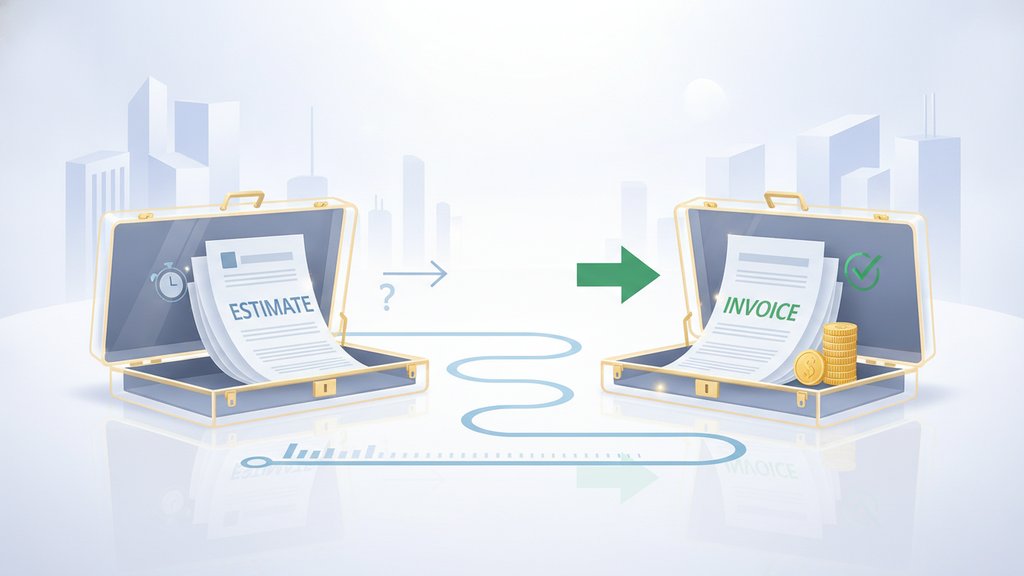
An estimate and an invoice are both billing documents, but they serve completely different purposes and carry different legal weight. The core difference between invoice and estimate is timing and commitment: an estimate comes before the work begins and is a projection of cost, while an invoice comes after (or during) the work and is a formal request for payment.
Getting these two mixed up, or sending the wrong one at the wrong time, can create confusion for clients, delay your payments, and even create legal headaches. Here is exactly when to use each one and why it matters.
Content Table
What Is an Estimate
An estimate (sometimes called a quote or proposal) is a document you send to a potential client before any work starts. It lays out the expected scope, the projected cost, and the conditions under which you would do the work. Think of it as an educated offer, not a binding bill.
Key characteristics of an estimate:
- It is not a payment request. The client owes you nothing just because they received it.
- The numbers can change if the scope changes, depending on how you word it.
- It is typically valid for a limited window of time (more on that below).
- It may require a client signature or written approval before work begins.
Estimates are common in construction, freelance design, consulting, home services, and any field where the final cost depends on variables that are not fully known upfront.
What Is an Invoice
An invoice is a formal, legally significant document that requests payment for goods or services already delivered (or in progress). Once you send an invoice, you are telling the client: "The work is done, here is what you owe, and here is when it is due."
Key characteristics of an invoice:
- It creates a legal obligation for the client to pay.
- It records a specific amount owed, not an approximation.
- It includes a due date, which triggers late-payment terms if unpaid.
- It is part of your official accounting records and may be required for tax purposes.
If you want to understand how an invoice differs from other payment documents like receipts or bills, the distinctions matter in accounting. You can read more about how an invoice differs from a receipt and what each one proves, or check out the breakdown of whether an invoice and a bill are actually the same thing in accounting terms.
Estimate vs Invoice: Key Differences at a Glance
| Feature | Estimate | Invoice |
|---|---|---|
| When it is sent | Before work begins | After work is completed or in progress |
| Legal obligation | None (until accepted) | Yes, client owes the stated amount |
| Amounts shown | Projected / approximate | Final / exact |
| Purpose | Win the job / set expectations | Request payment |
| Expiration | Usually expires (7-30 days is common) | Has a payment due date, not an expiry |
| Appears in accounting | No (unless converted) | Yes, as accounts receivable |
When to Send an Estimate
Send an estimate any time a client asks "how much will this cost?" before committing. Specific scenarios where an estimate is the right document:
- Project-based work with variable scope (a kitchen renovation, a website redesign, a branding project). The final cost may shift as details emerge.
- Competitive bidding situations where multiple vendors are quoting on the same job.
- New client relationships where you want to set clear expectations before any money is discussed.
- Large or complex jobs where the client needs internal budget approval before giving you a green light.
A good estimate includes your business name and contact details, the client's details, a clear description of the work, itemized costs, the total, any assumptions or exclusions, and an expiration date.
Once an invoice is sent and goes unpaid past its due date, it becomes overdue. Understanding what happens at that point, including your options for following up and charging late fees, is worth knowing. You can find a full breakdown of what a past due invoice means and when it officially becomes overdue.
Moving From Estimate to Invoice
The estimate-to-invoice workflow is one of the most important processes in any service business. Here is how it typically works in practice:
- Send the estimate. The client reviews the projected costs and scope.
- Client approves. They either sign the estimate, reply in writing, or sign a separate contract. This approval is your green light.
- Do the work. Track any scope changes. If costs are going to exceed the estimate significantly, notify the client before you proceed, not after.
- Convert to invoice. Use the approved estimate as the basis for your invoice. If the final numbers match, the transition is simple. If they changed, document why.
- Send the invoice. The client now has a formal payment obligation with a due date.
A common mistake is treating these two steps as interchangeable. They are not. Sending an invoice when you meant to send an estimate can pressure a client who has not yet agreed to anything. Sending an estimate when you meant to send an invoice means you are not actually requesting payment, which delays your cash flow.
Proposal Expiration Dates: Why They Matter
Every estimate or quote should include an expiration date, sometimes called a proposal expiration date or expiration quote date. This is the date after which the prices and terms in your estimate are no longer guaranteed.
Why this matters:
- Material and labor costs change. A quote valid for 30 days protects you if a client comes back six months later expecting the same price after your costs have risen.
- It creates urgency. A client who knows the quote expires in 14 days is more likely to make a decision than one who assumes the offer stands indefinitely.
- It keeps your schedule open. Without an expiration, a client could accept a quote months later and expect you to fit them in immediately.
A typical expiration window is 14 to 30 days for most service businesses. Construction and manufacturing quotes sometimes expire in as little as 7 days due to volatile material prices. According to general contract law principles around offer and acceptance, an offer that has not been accepted within a reasonable time or before its stated expiry can be withdrawn without obligation.
When the expiration date passes and the client still wants to proceed, simply issue a revised estimate with updated pricing and a new expiration date. Never just extend the original without reviewing whether your costs have changed.
One more document worth knowing about in this space is the credit note, which comes into play when an invoice has already been issued but needs to be partially or fully reversed. It is a different document again, used specifically to correct or cancel a billing already in your accounting records.
Ready to send the right document at the right time?
Use our free invoice generator to create professional invoices in minutes, no sign-up needed. Whether you are converting an estimate to invoice or billing a client for the first time, the tool handles the formatting so you can focus on the work.
Create Your Invoice Free →
Yes, under certain conditions. If a client formally accepts your estimate in writing (signs it, emails approval, or countersigns a contract that references it), the estimate can function as a binding agreement. At that point, both parties are committed to the scope and price outlined. This is why the wording on your estimate matters and why you should always document client acceptance before starting work.
In everyday business use, people treat them as interchangeable, but there is a subtle distinction. A quote is typically a fixed-price offer: if the client accepts it, that is exactly what they pay. An estimate is more of an approximation that may change if the scope shifts. In practice, always clarify in the document itself whether the price is fixed or subject to change based on final scope.
For most service businesses, 14 to 30 days is the standard window. If your costs depend on materials with volatile pricing (lumber, metals, fuel), shorten it to 7 to 14 days. For stable, low-cost services like graphic design or copywriting, 30 days is reasonable. Always state the expiration date explicitly in the document so there is no ambiguity if a client comes back weeks later.
Not always. For fixed-price products, recurring retainers, or clients you have an ongoing relationship with under a standing contract, you can go straight to invoicing. Estimates are most valuable when the scope is new, variable, or requires client approval before you commit resources. If the price and scope are already agreed in a contract, the estimate step is often redundant.
This is a common friction point. The safest approach is to notify the client as soon as you know costs will exceed the estimate, ideally before you do the additional work. Get written approval for the revised amount. If you simply send a higher invoice without warning, clients may dispute it or refuse to pay the difference. A change order or revised estimate signed by the client protects both sides.
They are similar but not identical. A proforma invoice looks like a real invoice and shows a projected total, but it is not a payment demand. It is commonly used in international trade to declare the value of goods before shipment, or to give a buyer a preview of charges before the final invoice is issued. An estimate is more of a sales-stage document, while a proforma sits closer to the billing stage without being a final bill.