

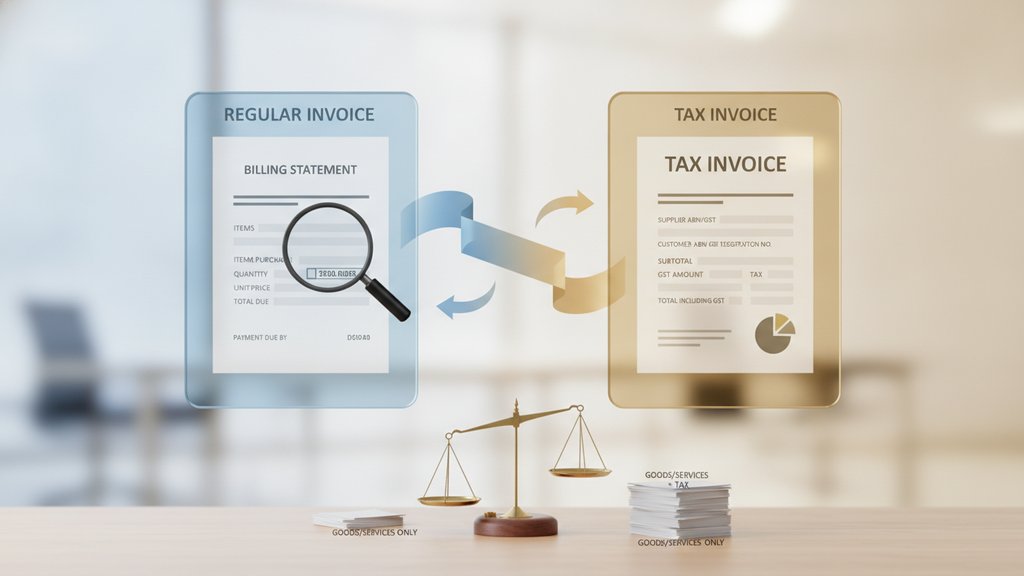
A tax invoice and a regular invoice are not the same document, even though they look similar at first glance. The core difference comes down to tax compliance: a tax invoice includes specific details required by your country's tax authority so that the buyer can legally claim a tax credit or deduction, while a standard invoice is simply a request for payment. Understanding the invoice vs tax invoice distinction matters because using the wrong document can get a tax claim rejected or land you in trouble during an audit.
Content Table
What Is a Regular Invoice
A regular invoice is a document a seller sends to a buyer to request payment for goods or services. It records the transaction: what was sold, how much it costs, and when payment is due. There is no legal requirement for it to reference any tax system, and it does not need to follow a government-mandated format.
Regular invoices are common in:
- Business-to-consumer (B2C) transactions where the buyer is not registered for tax
- Freelance or service work where no VAT or GST applies
- Jurisdictions or transaction types that fall below a tax registration threshold
- Internal billing between departments of the same company
If you want to understand how invoices compare to related documents like bills or estimates, it helps to read about the difference between an invoice and a bill and how estimates and invoices serve different purposes at different stages of a sale.
What Is a Tax Invoice
A tax invoice is a legally recognized document that proves a taxable transaction took place. It gives the buyer the evidence they need to claim an input tax credit (ITC), a VAT refund, or a GST credit from their tax authority. Without a valid tax invoice, that claim gets denied.
Tax invoices are required in countries that operate a value-added tax (VAT) or goods and services tax (GST) system. That includes most of the EU, the UK, Australia, Canada, and many others. In Australia, for example, the Australian Tax Office requires a tax invoice for any GST-creditable purchase over AUD 82.50. In the EU, the European Commission's VAT Directive sets out mandatory fields that every VAT invoice must carry.
Key Differences Side by Side
| Feature | Regular Invoice | Tax Invoice |
|---|---|---|
| Primary purpose | Request payment | Request payment AND satisfy tax law |
| Tax registration number required | No | Yes (VAT/GST number of seller, often buyer too) |
| Tax amount shown separately | Optional | Mandatory |
| Sequential invoice number | Recommended | Legally required |
| Allows buyer to claim tax credit | No | Yes |
| Governed by tax authority rules | No | Yes |
| Typical use case | B2C, non-taxable goods, below threshold | B2B taxable transactions above threshold |
What Goes on a Tax Invoice
The exact fields vary by country, but most tax authorities require a core set of elements. Here is what a tax invoice typically must include:
- The words "Tax Invoice" (or "VAT Invoice" depending on jurisdiction) clearly stated on the document
- A unique, sequential invoice number so the tax authority can audit the transaction trail
- Invoice date and, in some countries, the tax point date (the date the tax liability arises)
- Seller's full legal name and address
- Seller's VAT/GST registration number
- Buyer's name and address (and VAT number for B2B transactions in the EU)
- Description of goods or services with quantity and unit price
- Tax rate applied (e.g., 20% VAT, 10% GST)
- Net amount (before tax), tax amount , and gross total shown separately
- Currency of the transaction
Requirements differ meaningfully between jurisdictions. Germany requires the buyer's VAT number on B2B invoices. Australia mandates the ABN (Australian Business Number). Canada uses the GST/HST registration number. The rules are not universal, which is why checking country-specific requirements matters.
When to Issue a Tax Invoice
You need to issue a tax invoice when all of the following are true:
- You are registered for VAT or GST in your country
- The transaction involves a taxable supply of goods or services
- The transaction value is above your country's minimum threshold (if one applies)
- The buyer is also registered for tax and intends to claim a credit
Timing rules also apply. In the EU, a VAT invoice must generally be issued by the 15th day of the month following the month in which the taxable event occurred. In Australia, a tax invoice must be issued within 28 days of the buyer requesting one. Missing these deadlines can trigger penalties.
If you are selling to consumers (B2C) and the buyer has no intention of claiming a tax credit, a simplified invoice or a standard receipt may be acceptable in many jurisdictions. But for any B2B sale where the buyer is VAT/GST-registered, a full tax invoice is almost always required.
Is a Tax Invoice a Receipt
No. A tax invoice is not a receipt, and confusing the two is a common mistake. Here is the practical difference:
- A tax invoice is issued before or at the time of payment. It is a demand for payment and a tax compliance document.
- A receipt is issued after payment. It confirms that money has changed hands.
A receipt does not give the buyer the right to claim a tax credit. Only a valid tax invoice does. Some businesses issue a combined document (a "tax invoice/receipt") after payment, which can serve both purposes simultaneously. This is common in retail and hospitality. But if someone asks you for a tax invoice and you hand them only a receipt, they cannot use it for tax purposes.
For a deeper look at how these documents differ, see this breakdown of invoices versus receipts and when each one applies.
Tax Invoice Compliance by Country
Tax invoice rules are set at the national level, and they vary more than most people expect. A few examples:
- EU member states: All follow the EU VAT Directive (2006/112/EC), but each country can add its own requirements on top. France, Italy, and Germany all have additional national rules.
- Australia: Tax invoices are required for GST-registered businesses on supplies over AUD 82.50. Supplies under AUD 1,000 can use a simplified format.
- United Kingdom: Post-Brexit, the UK follows its own VAT rules under HMRC. Full VAT invoices are required for most B2B sales.
- Canada: GST/HST invoices must include the supplier's GST/HST registration number and a clear breakdown of the tax charged.
- United States: There is no federal VAT, so there is no standard "tax invoice" requirement at the federal level. Sales tax rules vary by state and are typically handled separately.
Many countries are also moving toward mandatory e-invoicing, which adds another layer of compliance. If you operate in Europe, the shift to structured digital formats is already underway in several countries, and more mandates are coming. You can get a full picture of which countries require it and when in this guide to EU e-invoicing mandates.
If you want to check the exact required fields for a specific country, the invoice requirements tool at BlueInvoice's invoice requirements guide lets you select a country and see a complete checklist of mandatory fields, common mistakes to avoid, and links to the official legal sources.

Not sure what your tax invoice must include?
The invoice vs tax invoice distinction comes down to required fields. Our country-specific invoice requirements guide shows you exactly which fields are legally mandatory in your country, common mistakes to avoid, and links to official tax authority sources.
Check Invoice Requirements →
No. If you are not registered for VAT or GST, you cannot charge tax and therefore cannot issue a tax invoice. You would issue a standard invoice without any tax line. If your revenue grows past the registration threshold in your country (for example, £90,000 in the UK or AUD 75,000 in Australia), you must register and then start issuing compliant tax invoices.
Yes, in practice that is exactly how it works. A tax invoice is essentially a regular invoice that meets all the additional requirements your tax authority sets. If you add your VAT registration number, show the tax rate and amount separately, include a sequential invoice number, and label the document correctly, it becomes a valid tax invoice. The format matters less than whether all mandatory fields are present.
They are functionally the same document. "Tax invoice" is the term used in countries with a GST system, like Australia and Canada. "VAT invoice" is the term used in the EU and the UK. Both serve the same purpose: they are legally compliant invoices that allow the buyer to reclaim the tax they paid. The terminology differs by jurisdiction, but the concept and the required content are nearly identical.
If a tax invoice has errors, the buyer may be unable to claim their tax credit, and you may face penalties during an audit. The correct fix is to issue a credit note canceling the original invoice and then issue a new, corrected tax invoice. You should not simply edit and resend the original document, as most tax authorities require a clear paper trail showing the correction was made formally.
Retention requirements vary by country but are typically between 5 and 10 years. In Germany, the legal retention period is 10 years. In Australia, it is 5 years. In the UK, HMRC requires 6 years for VAT records. Both the seller and the buyer are responsible for keeping their copies. Failing to retain invoices can result in fines and complications if you are ever audited.
No. A pro forma invoice is a preliminary document sent before a sale is confirmed. It is essentially a detailed quote or estimate showing what the final invoice will look like. It does not create a tax liability and cannot be used to reclaim VAT or GST. A tax invoice is issued after the sale is agreed and creates a legal obligation to pay, along with a tax liability for the seller.