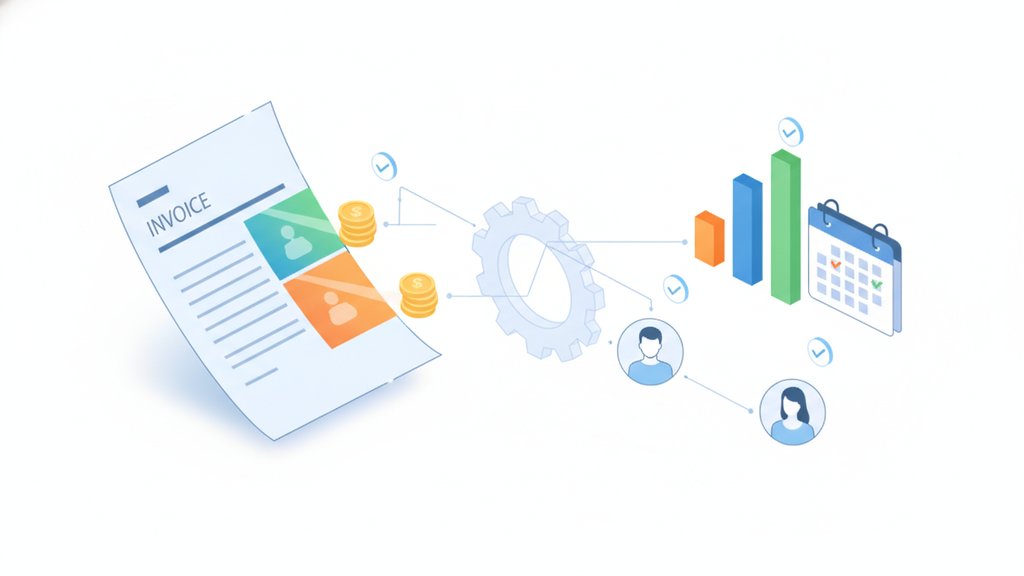
A partial payment invoice is a bill that asks the client to pay one slice of a larger total instead of the whole thing at once, usually split into staged or scheduled chunks tied to dates or completed work. Split invoicing lets you collect a deposit up front, bill progress payments as a project moves along, and send a final invoice when everything wraps up, which protects your cash flow and lowers the risk of doing weeks of work for free. It is how freelancers, contractors, and agencies turn one big payable into a few smaller, predictable ones.
Content Table
What a partial payment invoice actually is
Instead of one invoice for the full amount, you send several invoices that each cover a portion of the agreed price. The total stays the same; you just collect it in pieces. A $6,000 website build might become a $2,000 deposit, a $2,000 invoice at the design-approval stage, and a $2,000 invoice on launch.
This matters most when:
- The project runs long. Waiting 8 weeks for a single payment strains your cash flow.
- The total is large. Asking for $20,000 in one shot makes clients nervous and slows approvals.
- You buy materials or subcontract. A deposit covers your out-of-pocket costs before you start.
The main ways to split an invoice
There is no single "right" method. Pick the one that matches how your work is structured.
| Billing method | How it splits | Best for |
|---|---|---|
| Deposit + balance | A set percentage up front (often 25-50%), rest on completion | Short projects, custom orders, event work |
| Milestone invoicing | Payments tied to deliverables (design done, build done, launch) | Web builds, design, construction, software |
| Installment billing | Equal amounts on a fixed schedule (e.g. 3 monthly payments) | Coaching packages, retainers, high-ticket products |
| Staged payments | Chunks released as work phases finish, amounts can vary | Long contracts, renovations, multi-phase consulting |
Milestone invoicing is the favorite for project-based work because each payment is linked to something the client can see and approve. That makes disputes rare: if the design phase is signed off, the design invoice is hard to argue with.
How to set up split invoicing step by step
- Agree the split before any work starts. Put the schedule in your contract or proposal: amounts, triggers, and dates. Verbal agreements fall apart fast when money is involved.
-
Number your invoices clearly.
Use a system like
INV-2025-014-1,-2,-3, or label them "Deposit," "Progress," and "Final" so nobody loses track of what is paid. - Reference the full contract value on every invoice. Show the total, what this invoice covers, and the running balance still owed.
- Send the deposit invoice first and wait for payment. Do not start until the first slice clears, especially with new clients.
- Trigger each new invoice as its milestone is met. Tie the send to a real event, not a guess.
- Send a clear final invoice. List every prior payment received and the remaining balance so the math is obvious.
If you bill on the go, you can issue each staged invoice straight from your phone the moment a milestone is approved, no desktop required. See our guide on invoicing clients from your phone for how that works without downloading an app.
What every partial invoice must show
A partial invoice still has to function as a complete, valid invoice on its own. At minimum, include:
- Your business name, address, and tax/VAT number
- The client's details
- A unique invoice number and issue date
- The due date for this payment
- A line that names the milestone or stage being billed
- The total contract value and the balance remaining
- Tax applied to this portion, calculated correctly
The line description does a lot of heavy lifting here. "Payment 2 of 3: Design phase complete (per contract dated Jan 12)" leaves no room for confusion. Our breakdown on writing clear invoice line items shows how to phrase these so clients pay faster.
Common mistakes to avoid
- Starting work before the deposit lands. The deposit exists to filter out clients who will not pay. Skipping it defeats the point.
- Vague milestones. "When the project is mostly done" invites arguments. Use concrete, signed-off triggers.
- Losing track of the running total. If you cannot instantly say how much is paid and how much is left, your client will not trust the final invoice.
- Forgetting to chase late slices. A missed milestone payment is an overdue invoice like any other, and waiting only makes it worse.
- Mismatched numbering. Re-using the same invoice number for two slices wrecks your bookkeeping and confuses accountants at tax time.
Set your split up front, tie every invoice to a real trigger, and keep the running balance visible. Do that and partial payments become the steady, predictable cash flow most freelancers and agencies wish they had from day one.

Create a partial payment invoice in minutes
Use our free invoice generator to build a split payment invoice with deposit, milestone, and final stages, complete with the running balance and tax on each slice.
Create Your Invoice →
Most freelancers and agencies ask for 25% to 50% up front. Use the higher end for new clients, large material costs, or long projects, and the lower end for repeat clients you trust. The deposit should at least cover your out-of-pocket costs before work begins.
Yes. Each partial invoice is a real, enforceable request for payment once issued, just like a full invoice. As long as it contains the required details and references an agreed contract or proposal, the client legally owes that amount by its stated due date.
Milestone invoicing ties each payment to a completed deliverable, like a finished design phase. Installment billing splits the total into equal amounts on a fixed calendar schedule, regardless of progress. Milestones suit project work; installments suit packages, retainers, and high-ticket purchases paid over time.
Apply tax to each portion as you bill it rather than all at the end. If a $6,000 plus tax project splits into three, each invoice carries one-third of the tax. Deposit tax timing varies by country, so check your local VAT or sales tax rules to stay compliant.
Give each slice a unique number and link them clearly, such as INV-2025-014-1, -2, and -3, or label them Deposit, Progress, and Final. Reference the full contract value and running balance on every one so your books and your client's records always reconcile.