


Knowing how long to keep financial records is one of those things most freelancers and small business owners put off until a tax audit or legal dispute forces the question. The short answer: most countries require you to keep invoices and tax-related records for at least 5 to 7 years, but the exact requirement depends on where you operate and what type of record you're storing. Getting this wrong can mean penalties, failed audits, or lost disputes with clients.
Content Table
- Why Invoice Retention Actually Matters
- Retention Requirements by Country (US, UK, EU)
- Tax Records vs. General Invoice Storage
- What Happens If You Don't Keep Records Long Enough
- Digital vs. Physical Invoice Storage
- How to Organize and Store Invoices Efficiently
- How BlueInvoice Handles Invoice Storage Automatically
Why Invoice Retention Actually Matters
Invoice record keeping isn't just a compliance checkbox. Invoices are your primary evidence in three real-world situations:
- Tax audits: Tax authorities can request proof of income and deductible expenses going back several years. Without invoices, you have no defense.
- Client disputes: If a client claims they never received an invoice or contests the amount, your stored copy is the evidence that settles it.
- Business financing: Banks and investors often want to see years of invoicing history before approving loans or funding rounds.
The rules differ quite a bit depending on your country, your business type, and whether you're dealing with VAT or sales tax. Let's break it down concretely.
Retention Requirements by Country (US, UK, EU)
| Country / Region | Minimum Retention Period | Governing Body / Law | Notes |
|---|---|---|---|
| United States | 3 to 7 years | IRS | 3 years for standard returns; 6 years if you underreported income by more than 25%; 7 years for bad debt claims |
| United Kingdom | 6 years | HMRC | 5 years after the 31 January submission deadline for self-employed; limited companies must keep records for 6 years from the end of the accounting period |
| European Union (general) | 5 to 10 years | EU VAT Directive + national laws | Varies by member state; Germany requires 10 years, France requires 10 years, Spain requires 4 years for tax but 5 years for commercial records |
| Germany | 10 years | Abgabenordnung (AO) | One of the strictest in the EU; applies to all business-related documents including invoices |
| France | 10 years | Code de commerce | Applies to accounting documents and invoices; VAT records follow the same timeline |
| Canada | 6 years | CRA | 6 years from the end of the tax year the records relate to |
| Australia | 5 years | ATO | 5 years from when you prepared or obtained the record, or completed the transaction |
For EU businesses specifically, the EU e-invoicing requirements are also changing rapidly, with several countries now mandating structured digital invoice formats. That affects not just how long you store invoices, but what format they must be stored in.
Tax Records vs. General Invoice Storage
Not every invoice carries the same legal weight. There's a meaningful difference between records you must keep for tax compliance and invoices you keep for general business purposes.
Tax-related invoice records
These are invoices directly tied to your tax filings: income invoices that appear on your tax return, expense invoices you're claiming as deductions, and VAT invoices used to reclaim input tax. These are the records tax authorities will ask for during an audit, and they must be kept for the full statutory period (see table above).
General business invoice storage
Invoices that don't affect your tax position directly (such as proforma invoices, quotes, or internal billing between departments) typically fall under commercial law rather than tax law. In most countries, commercial law requires keeping these for 5 to 6 years, but the exact period is often shorter than the tax requirement.
What Happens If You Don't Keep Records Long Enough
Failing to maintain adequate invoice records has concrete consequences, not just theoretical ones.
- Failed tax audits: In the US, if the IRS requests documentation you can't produce, they can disallow your deductions entirely and assess additional tax plus interest and penalties.
- VAT reclaim rejections: In the EU and UK, HMRC or national VAT authorities can reject input VAT claims if you can't provide the original invoice. This can mean repaying VAT you already reclaimed.
- Lost client disputes: Without a stored invoice, proving the agreed price, payment terms, or delivery scope in a dispute becomes very difficult. Courts generally require documentary evidence.
- Fines for non-compliance: Some jurisdictions (Germany is a notable example) can issue fines specifically for failure to maintain records, separate from any tax underpayment.
- Complications during business sale or funding: Buyers and investors typically conduct due diligence on financial records. Gaps in your invoice history can kill a deal or reduce your valuation.
Digital vs. Physical Invoice Storage
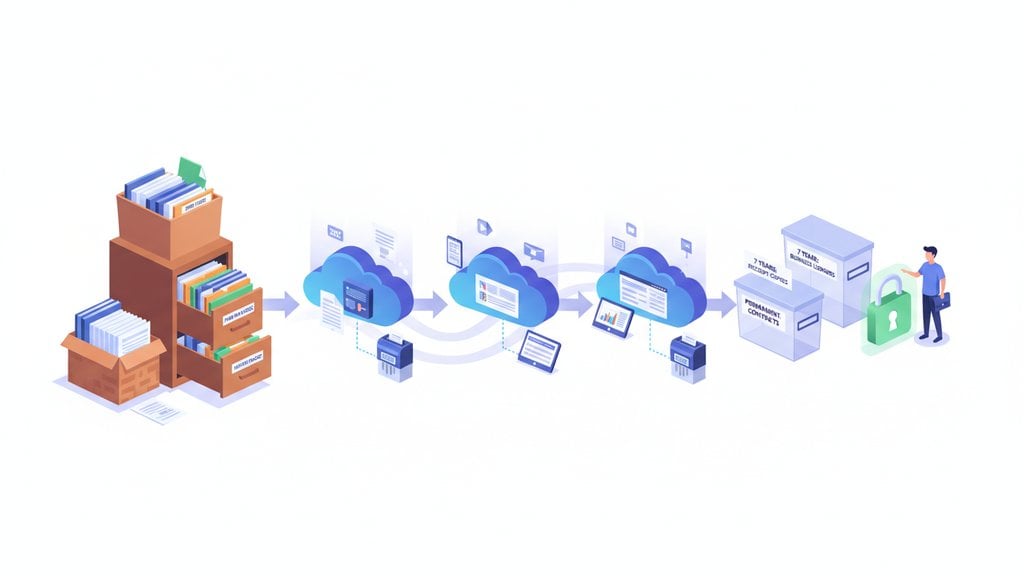
Most countries now fully accept digital invoice storage, and in many cases prefer it. The key requirement is that the stored record must be a faithful, unaltered copy of the original.
Physical (paper) storage
- Still legally valid everywhere
- Vulnerable to fire, flooding, and physical deterioration over a 7 to 10 year retention period
- Difficult to search and retrieve quickly during an audit
- Takes up real space and has ongoing filing costs
Digital storage
- Accepted in all major jurisdictions including the US, UK, EU, Canada, and Australia
- Must be stored in a format that cannot be easily altered (PDF/A is a common standard for archival purposes)
- Must be retrievable and legible for the full retention period
- EU rules under the VAT Directive require that digitally stored invoices guarantee authenticity of origin and integrity of content
- Cloud-based storage with automatic backup is generally safer than a local hard drive for long-term retention
If you're operating within the EU, it's also worth understanding the EU e-invoicing mandates that are rolling out across member states. Several countries now require invoices to be issued in structured XML formats (like UBL or CII), which also affects how you store and archive them.
How to Organize and Store Invoices Efficiently
Compliance records are only useful if you can actually find them when needed. Here's a practical system that works for freelancers and small businesses alike.
Folder structure that scales
Whether you're storing files locally or in the cloud, a consistent folder structure saves hours when an auditor or client asks for a specific invoice. A simple approach that works:
- Top level: Year (e.g., 2023, 2024)
- Second level: Month or Quarter (e.g., Q1, Q2, or 01-January)
- Third level: Client name or invoice type (e.g., "Acme Corp", "Expenses")
Naming conventions
Use a consistent file naming format for every invoice. A good pattern is:
YYYY-MM-DD_ClientName_InvoiceNumber.pdf
. This makes invoices sortable by date automatically and searchable by client name.
What to store alongside the invoice
For each invoice, keep any related documents together: the purchase order it fulfills, the delivery confirmation, and any payment receipt. Tax authorities often want to see the full transaction chain, not just the invoice itself.
Regular archiving schedule
Set a recurring task (monthly or quarterly) to move finalized invoices into your archive folder and confirm backups are working. Waiting until year-end means you'll be sorting through a year's worth of documents at once.
For freelancers who want a deeper look at setting up a professional invoicing workflow from the start, the freelancer's guide to professional invoicing covers everything from invoice structure to payment follow-up.
How BlueInvoice Handles Invoice Storage Automatically
Manual filing is where most freelancers fall behind. BlueInvoice removes that friction by automatically saving every invoice you create to your account, without any manual export or filing step on your part.
Here's how it works in practice:
- Every invoice you create is saved automatically with a 1.2-second autosave. You don't need to hit a save button or export to PDF to preserve the record.
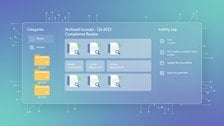
- All your invoices live in the My Invoices workspace, accessible at any time after logging in.
- You can organize invoices into named folders (for example, one folder per client or per year) using the sidebar. Every account starts with a default "General" folder, and you can create as many additional folders as you need.
- Invoices can be renamed, copied, moved between folders, or duplicated for repeat clients using right-click context actions.
- If you created invoices before signing up (stored locally in your browser), you can sync them to your account after logging in using the "Save to Account" option.
The result is a searchable, organized archive of all your invoices that you can pull up instantly during an audit, client dispute, or year-end tax review. No digging through email attachments or local folders with inconsistent naming.
Stop losing track of invoices you're legally required to keep
BlueInvoice automatically saves every invoice you create to your account with autosave, so your invoice record keeping is always up to date. Organize past invoices into folders by client or year and retrieve any record in seconds, whether it's for a tax audit or a client dispute.
Try BlueInvoice Free →
Yes, absolutely. Self-employed individuals and sole traders are subject to the same invoice record keeping requirements as incorporated businesses in most countries. In the US, the IRS expects freelancers to retain income and expense records for at least 3 to 7 years. In the UK, HMRC requires self-employed individuals to keep records for at least 5 years after the submission deadline for the relevant tax year.
Technically yes, once the statutory retention period has passed, you're no longer legally required to keep the records. However, there are practical reasons to keep them longer, such as ongoing client relationships, potential warranty or liability claims, or business history for financing purposes. If you do delete them, make sure any personally identifiable information is handled according to applicable data protection rules like GDPR.
In most jurisdictions, yes. The US, UK, and EU all accept digital copies of original paper invoices, provided the scan is a clear, complete, and unaltered reproduction. The key requirement is that the digital copy must be legible and retrievable for the full retention period. Saving scans as PDF/A format is best practice for long-term archival. Some countries require you to keep the original paper copy as well, so check your local rules if you plan to discard originals after scanning.
This is a real risk with cloud-based tools. Tax authorities generally do not accept "my software provider went out of business" as an excuse for missing records. You are personally responsible for maintaining your financial records. Best practice is to regularly export your invoices as PDF files and store them in a separate location (a personal cloud drive or local backup) independent of any single invoicing platform. Treat your invoicing software as a working tool, not your permanent archive.
The same retention rules apply to expense invoices (invoices you received from suppliers or contractors) as to the invoices you issue to clients. If you're claiming an expense as a tax deduction or reclaiming VAT on it, you need the original invoice as proof. In the US, keep expense records for at least 3 to 7 years. In the UK and most EU countries, the standard is 5 to 10 years depending on the country. When in doubt, apply the longer period.
Yes. There is generally no minimum threshold below which you're exempt from keeping records. Small cash transactions are often the ones tax authorities scrutinize most closely, because they're easier to underreport. In the UK, HMRC expects records of all business income and expenses regardless of amount. In the US, the IRS applies the same standards to all taxable transactions. For very small incidental expenses, a receipt or simple log entry may suffice, but keep something.