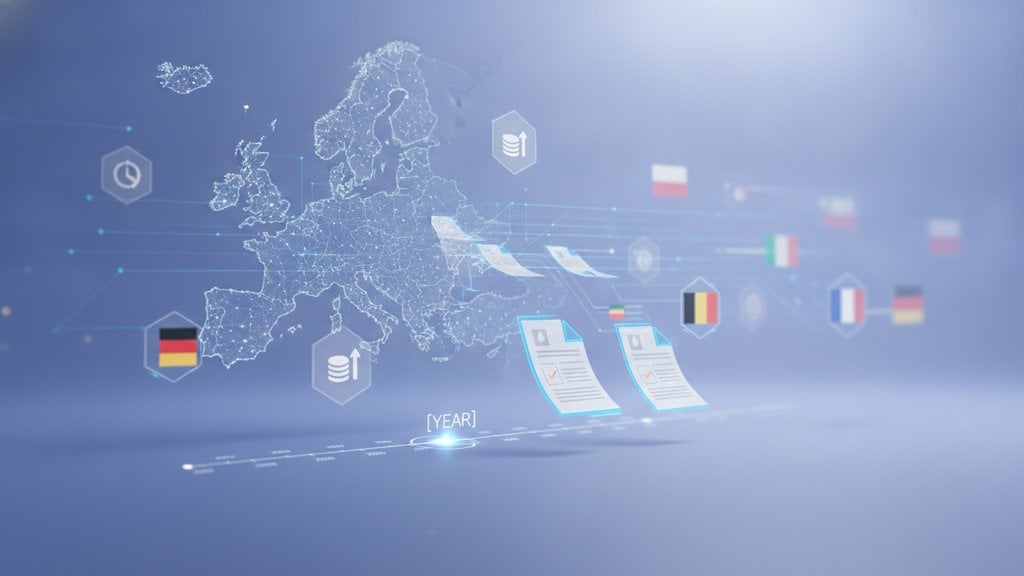
If you sell goods or services across EU borders, understanding EU e-invoicing requirements by country is no longer optional. The European Union is moving fast toward mandatory electronic invoicing, and the rules differ significantly from one member state to the next. Some countries already require structured digital invoices for all B2B transactions. Others are still in pilot phases. Missing a deadline or using the wrong format can trigger penalties, delayed payments, or rejected invoices. This guide cuts through the noise and gives you a clear, country-by-country picture of where things stand, what formats are accepted, and what you should do right now to stay compliant.
Content Table
- What Is EU E-Invoicing and Why Does It Matter
- ViDA - The EU Regulation Reshaping Everything
- Country-by-Country E-Invoicing Rollout Table
- Peppol and EN 16931 - The Technical Standards You Need to Know
- Case Study - How an Italian SaaS Company Navigated the Mandate
- Actionable Steps to Get Compliant Before Your Deadline
- Conclusion
Key Takeaways:
- Several EU countries already enforce mandatory B2B e-invoicing, with more deadlines arriving in 2025 and 2026.
- The EU's ViDA regulation will standardize digital reporting across all member states by 2030.
- Peppol and EN 16931 are the dominant technical standards - your invoicing tool must support them.
- Non-compliance can mean rejected invoices, payment delays, and tax authority penalties.
What Is EU E-Invoicing and Why Does It Matter
Electronic invoicing (e-invoicing) is not simply sending a PDF by email. In the EU context, a true e-invoice is a structured data file - typically in XML or UBL format - that can be read, processed, and validated automatically by both buyer and seller systems without human re-keying. The goal is to reduce VAT fraud, cut processing costs, and speed up payment cycles across the single market.
The difference between a PDF invoice and a compliant e-invoice is significant. A PDF is a visual document. A structured e-invoice carries machine-readable data fields that tax authorities can cross-check in real time. This distinction matters because many EU mandates specifically require structured formats, not just digital delivery.
For SaaS companies and subscription businesses operating across borders, the stakes are especially high. You may be issuing hundreds or thousands of invoices per month. If your billing system cannot output the correct format for each country you operate in, you face a compliance gap that grows with your customer base.
ViDA - The EU Regulation Reshaping Everything
The most important regulatory development in recent years is the ViDA (VAT in the Digital Age) proposal, formally adopted by the EU Council in 2024. ViDA is not just another national pilot - it is a binding EU-wide framework that will require real-time digital reporting and structured e-invoicing for cross-border B2B transactions across all member states.
Key ViDA milestones include:
- 2024-2025: Member states gain the right to mandate domestic e-invoicing without needing individual EU derogations.
- 2030: Mandatory digital reporting for all intra-EU B2B transactions takes effect.
- 2035: OSS (One Stop Shop) and IOSS schemes expand further under digital reporting rules.
ViDA effectively removes the legal barriers that previously slowed national mandates. Countries can now move ahead independently, which is exactly what France, Germany, Belgium, and others are doing. You can read the official ViDA regulation details on the European Commission website.
Country-by-Country E-Invoicing Rollout Table
The table below reflects the most current publicly available information on mandatory e-invoicing Europe 2026 timelines and beyond. Deadlines and scope can shift, so always verify with local tax authorities before making system changes.
| Country | B2G Mandatory | B2B Mandatory | Key Deadline | Format / Platform | Status |
|---|---|---|---|---|---|
| Italy | Yes (since 2014) | Yes (since 2019) | Fully live | FatturaPA / SDI | Active - most advanced in EU |
| France | Yes (since 2017) | Phased rollout | Large companies: Sep 2026; SMEs: 2027 | Chorus Pro / Peppol | Rollout in progress |
| Germany | Yes | Receive mandate: Jan 2025; Issue mandate: phased to 2028 | Jan 2025 (receive); Jan 2027 (issue, large); Jan 2028 (issue, SME) | XRechnung / ZUGFeRD / Peppol | Receive mandate live |
| Belgium | Yes | Yes | Jan 2026 | Peppol | Mandatory from Jan 2026 |
| Poland | Yes | Yes | Feb 2026 | KSeF (National e-Invoice System) | Mandatory from Feb 2026 |
| Spain | Yes (since 2015) | Phased | Large companies: 2025; SMEs: 2026 | Facturae / Peppol | Rollout in progress |
| Portugal | Yes | Voluntary (structured format required for VAT) | Ongoing | SAFT-PT / Peppol | Partial mandate |
| Romania | Yes | Yes (large taxpayers since 2024) | 2024 (large); 2025 (all B2B) | RO e-Factura / Peppol | Expanding mandate |
| Netherlands | Yes (since 2019) | Not yet mandated | TBD (aligned with ViDA) | Peppol | B2G live; B2B voluntary |
| Sweden | Yes | Not yet mandated | TBD | Peppol / SFTI | B2G live; B2B voluntary |
| Greece | Yes | Via myDATA platform (real-time reporting) | 2024 (expanded scope) | myDATA | Real-time reporting active |
| Hungary | Yes | Real-time reporting (RTIR) since 2021 | Fully live | RTIR (NAV Online) | Active |
| Denmark | Yes (since 2005 - first in EU) | Not yet mandated | TBD | Peppol / OIOUBL | Pioneer; B2B voluntary |
| Austria | Yes | Not yet mandated | TBD | ebInterface / Peppol | B2G live; B2B voluntary |
Note: This table reflects information available as of 2026. Always confirm current requirements with the relevant national tax authority before making compliance decisions.
Peppol and EN 16931 - The Technical Standards You Need to Know
Two technical standards dominate EU e-invoicing: Peppol and EN 16931.
EN 16931 is the European standard for the semantic data model of an electronic invoice. It defines exactly which data fields an e-invoice must contain and in what structure. It is the baseline that all compliant e-invoice formats must conform to. If your invoicing software claims EU compliance, it should reference EN 16931 from CEN (European Committee for Standardization).
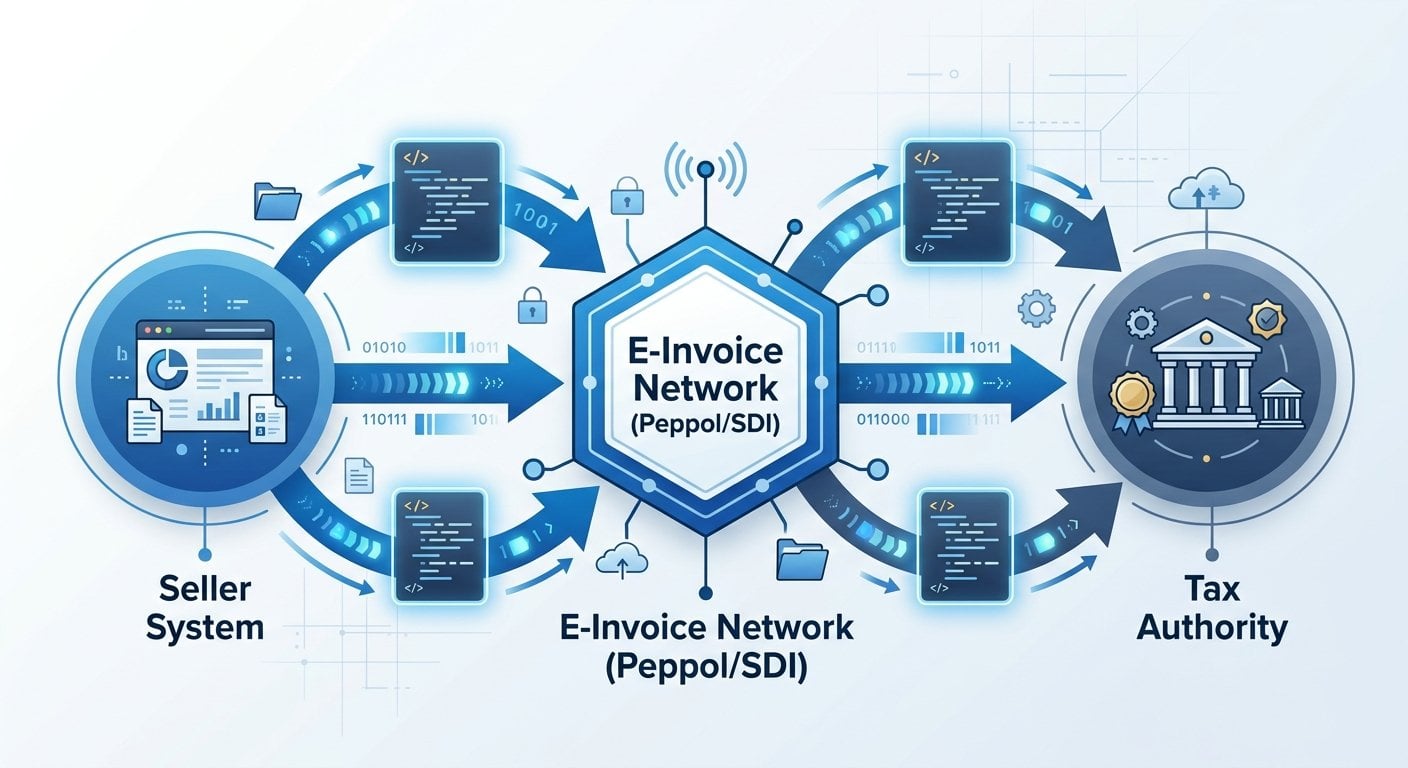
Peppol (Pan-European Public Procurement On-Line) is the network and delivery infrastructure that carries e-invoices between trading partners. Think of it as a secure postal system for business documents. Peppol uses access points - certified service providers - to route invoices between senders and receivers. Countries like Belgium, the Netherlands, Denmark, Sweden, and Romania have adopted Peppol as their primary B2G and increasingly B2B delivery channel.
Key practical points about Peppol e-invoicing countries:
- You need a Peppol-registered access point to send and receive invoices on the network.
- Your invoice must carry a valid Peppol ID for both buyer and seller.
- Peppol BIS Billing 3.0 is the most common profile used across EU member states.
- Not all countries use Peppol - Italy uses SDI, Poland uses KSeF, France uses Chorus Pro.
If you are a SaaS company issuing invoices to customers in multiple EU countries, your billing system needs to handle multiple formats simultaneously. This is where purpose-built invoicing tools become essential rather than optional. You can also explore our free invoice generator vs. paid software comparison to understand which level of tooling fits your situation.
Case Study - How an Italian SaaS Company Navigated the Mandate
Italy's e-invoicing mandate is the most mature in the EU, covering all domestic B2B transactions since January 2019. Here is how one mid-sized SaaS company - a project management platform based in Milan with around 800 business customers - dealt with the real constraints of compliance.
The situation: Before the mandate, the company sent PDF invoices by email. When the SDI (Sistema di Interscambio) mandate took effect, every invoice had to be submitted in FatturaPA XML format through the Italian Revenue Agency's exchange system. Invoices sent by email alone were no longer legally valid.
The real constraints they faced:
- Their existing billing system could not output FatturaPA XML without custom development.
- Each invoice needed a valid recipient code (Codice Destinatario) or certified email (PEC) address for the buyer.
- Invoices rejected by SDI had to be corrected and resubmitted within specific time windows.
- Foreign customers (non-Italian VAT numbers) required a different handling path.
What they did: They integrated a certified e-invoicing middleware service that sat between their billing system and SDI. They updated their customer onboarding form to collect Codice Destinatario at signup. They also trained their finance team on the rejection codes SDI returns, so errors could be corrected quickly rather than sitting unresolved.
The outcome: Within three months of going live, their invoice rejection rate dropped from 12% (in the first week) to under 1%. Payment cycles shortened because buyers received machine-readable invoices that could be auto-approved in their accounts payable systems. The compliance cost was real, but the operational benefit was measurable.
This example reflects a pattern you will see repeated as France, Germany, Belgium, and Poland roll out their own mandates. The companies that start early, collect the right data at onboarding, and use compliant tooling will have a smoother transition than those scrambling at the deadline.
Actionable Steps to Get Compliant Before Your Deadline
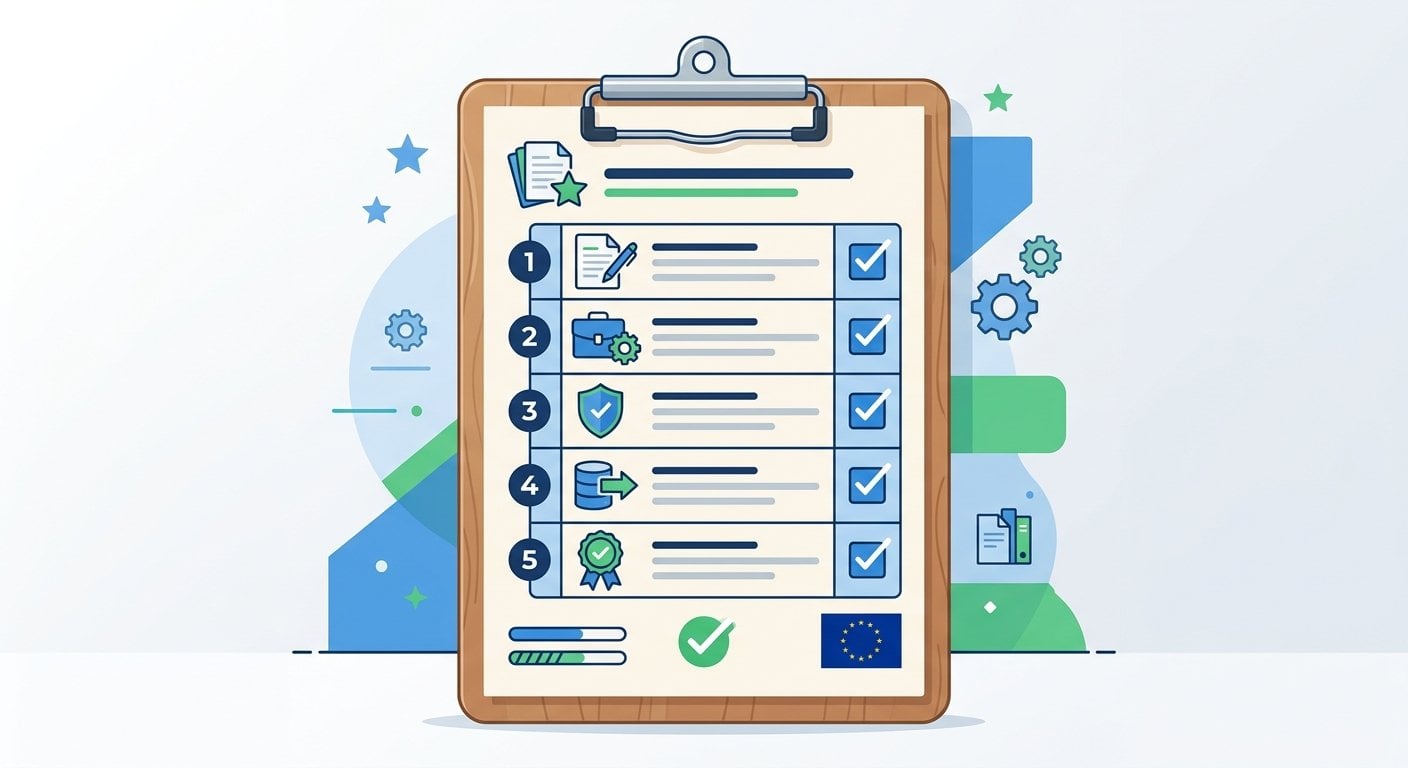
Whether your deadline is January 2026 or still being finalized, the steps to prepare are consistent. Here is a practical checklist:
- Identify which countries you invoice into. Map your customer base by country and cross-reference with the table above. Prioritize countries with firm 2025-2026 deadlines.
- Audit your current invoicing output. Can your billing system produce structured XML or UBL files? Can it connect to Peppol, SDI, KSeF, or Chorus Pro? If not, you have a gap to close.
- Collect missing buyer data now. Many mandates require buyer-specific identifiers (VAT number, Peppol ID, recipient code). Update your onboarding forms before the deadline, not after.
- Choose compliant tooling. For freelancers and small businesses, a modern invoicing tool that supports EN 16931 formats and Peppol connectivity is usually more cost-effective than custom development. See our invoice template guide for a starting point on invoice structure.
- Test before go-live. Every country's system has a test environment. Use it. Italy's SDI, Poland's KSeF, and France's Chorus Pro all offer sandbox testing. Rejections in test mode cost nothing. Rejections in production cost time and potentially penalties.
- Set up a rejection handling process. Know what error codes mean and who in your team is responsible for fixing and resubmitting rejected invoices.
- Monitor regulatory updates. The EU e-invoice mandate deadline landscape changes frequently. Subscribe to updates from your national tax authority and the European Commission.
For freelancers and sole traders, the compliance picture is similar but the tooling options are more accessible. Our freelancer invoicing guide covers the specific requirements you need to meet without over-engineering your setup.
Conclusion
The shift to mandatory e-invoicing across the EU is accelerating, not slowing down. ViDA has removed the legal friction that previously delayed national mandates, and countries like Belgium, Poland, France, and Germany are moving forward with firm deadlines in 2025 and 2026. The businesses that will navigate this most smoothly are those that treat compliance as an operational project - not a last-minute scramble. Audit your invoicing stack now, collect the right buyer data, and choose tools that support the formats your markets require. The cost of early preparation is far lower than the cost of rejected invoices and missed payments at deadline.

Check Your EU E-Invoicing Requirements in Seconds
Use our EU e-invoicing requirements tool to instantly see what your specific country mandates, which formats apply, and what deadlines you need to meet - no guesswork required.
Use Our Free Tool →
Not universally. Mandatory status varies by country and business size. Italy and Hungary have full B2B mandates active. Belgium and Poland go mandatory in early 2026. Germany, France, and Spain are rolling out phased mandates. Many countries still only require e-invoicing for government (B2G) transactions.
EN 16931 is the EU semantic data model standard that defines required invoice fields and structure. If you invoice businesses or government entities in any EU country with an e-invoicing mandate, your invoice format must conform to EN 16931. Most compliant invoicing software handles this automatically.
The invoice may be legally invalid, meaning the buyer cannot deduct input VAT and you may not be able to enforce payment. Tax authorities can also issue fines. In Italy, non-compliant invoices are treated as if they were never issued, which creates significant legal and cash flow problems.
Yes. ViDA's digital reporting requirements will apply to all intra-EU B2B transactions from 2030. This means structured e-invoices and near-real-time reporting to tax authorities for cross-border sales, not just domestic ones. Businesses trading across EU borders should plan for this now.
Peppol is widely supported but not universal. Belgium, Netherlands, Denmark, Sweden, and Romania use Peppol as a primary channel. Italy uses SDI, Poland uses KSeF, and France uses Chorus Pro. Some countries accept Peppol alongside their national platform. Always check the specific country's accepted delivery channels.