
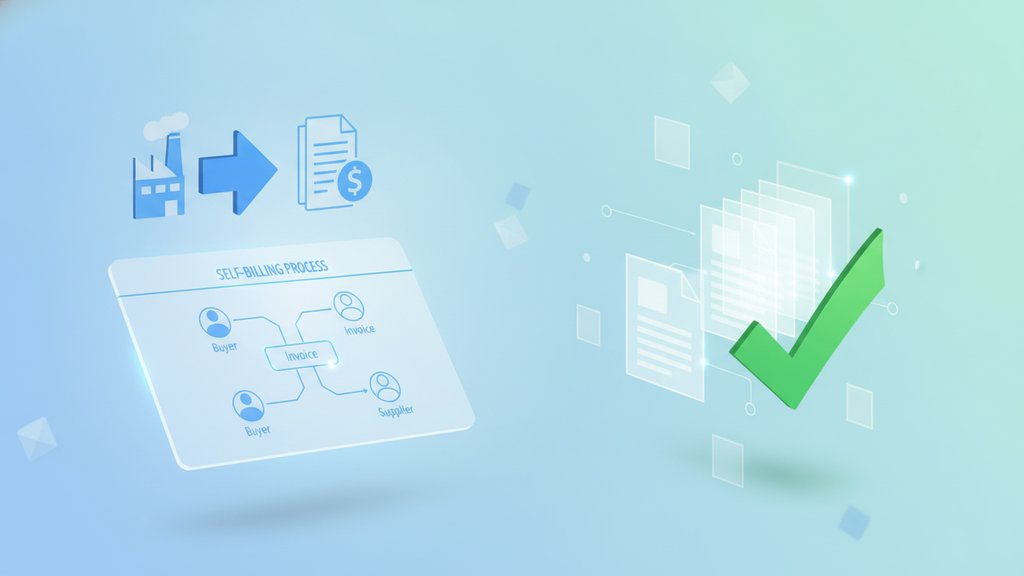
A self-billing invoice is an invoice that the buyer creates on behalf of the seller, instead of the seller sending it themselves. The buyer works out what it owes, generates the invoice document, and sends a copy back to the supplier, who then treats it as their own sales invoice. This "reverse billing" setup only works when both parties have signed a formal self-billing agreement first, and it's most common in industries where the buyer knows the exact quantities and prices before the supplier does.
Content Table
What a self-billing invoice actually is
Normally the seller writes the invoice and chases payment. Self-billing flips that around. In practice, the self billing invoice meaning is straightforward: the customer prepares a document that looks and functions like a supplier invoice, marks it clearly as self-billed, and uses it as the basis for payment and their own bookkeeping. Because the buyer created it, this is also called a buyer-created invoice or reverse billing.
The key point: it is still the supplier's invoice in legal and tax terms. The buyer is just doing the paperwork on the supplier's behalf. That's a different thing from a bill you receive and log as a purchase, and it's not a receipt confirming payment either. If those distinctions feel fuzzy, our breakdown of the difference between an invoice and a receipt clears it up.
Why the buyer issues the invoice
It sounds backwards until you look at who actually holds the numbers. In many arrangements the buyer knows the final amounts before the seller does:
- Variable quantities: A supermarket buying produce by weight knows the exact kilos delivered and the agreed price per kilo. The farmer doesn't know the till figure.
- Royalties and commissions: A publisher or platform calculates royalties from its own sales data, so it can bill on the author's behalf faster than waiting for an invoice.
- Volume-heavy purchasing: An automotive plant receiving parts from dozens of suppliers standardizes every invoice by generating them all itself.
The result is fewer disputes over figures, faster payment cycles, and one consistent invoice format across every supplier. For the supplier, it means less admin: no chasing, no formatting, no wondering whether the invoice matched the purchase order.
The self-billing agreement comes first
You cannot just start invoicing yourself for a supplier out of the blue. A valid self-billing agreement must be in place before the first invoice is issued. Most tax authorities require this to be a written agreement that both sides sign, and it usually covers:
- The supplier's consent to receive buyer-created invoices and not issue their own for the covered supplies.
- An expiry or review date (often 12 months) so the arrangement gets re-confirmed.
- A commitment from the supplier to tell the buyer if they deregister for VAT or change their VAT number.
- The types of goods or services the agreement covers.
VAT rules and what must appear on the invoice
For VAT self-billing, the document has to carry everything a standard tax invoice needs, plus a few extras that flag it as self-billed. In the UK and across the EU, a compliant self-billing invoice includes:
| Element | Detail required |
|---|---|
| The words "self-billing" | A clear marking such as "Self-billed invoice" on the face of the document |
| Supplier details | Name, address, and VAT registration number of the supplier |
| Buyer details | Name, address, and VAT number of the customer issuing it |
| Invoice number | A unique sequential number from the buyer's series |
| Supply details | Description, quantity, unit price, VAT rate, and VAT amount |
Because the supplier still owes the output VAT, they cannot ignore these invoices. They must account for the VAT the buyer calculated on their behalf. If your transactions also involve cross-border rules, it's worth checking how this interacts with reverse charge invoice requirements, since "reverse charge" and "reverse billing" are easy to mix up but mean completely different things.
For a fuller picture of what turns an ordinary document into a compliant one, see what makes a tax invoice different from a regular invoice.
Real-world scenarios where self-billing is used
Self-billing shows up wherever the buyer is the party with the authoritative data:
- Agriculture and food supply: processors and retailers paying farmers based on weighed, graded deliveries.
- Construction and subcontracting: main contractors self-billing subcontractors against measured work done on site.
- Publishing and music: royalty statements doubling as buyer-created invoices for authors and artists.
- Recruitment agencies: agencies self-billing contractors based on approved timesheets.
- Affiliate and platform payouts: marketplaces generating invoices for third-party sellers from internal sales figures.
In each case the supplier could invoice manually, but the buyer's records are simply more accurate and quicker to process at scale.
The self invoice meaning in live selling follows the same logic: the platform or host that holds the order data prepares the invoice on the seller's behalf, while the seller still accounts for the VAT shown on it.
Risks and responsibilities on both sides
Convenience comes with duties. The buyer must keep an up-to-date list of suppliers they self-bill, use the correct VAT number on every invoice, and stop self-billing the moment an agreement expires or a supplier deregisters. The supplier must not issue their own invoices for the same supplies (that would create duplicates) and must account for the VAT shown.
Get the setup right and self-billing quietly removes friction for both parties. Get it wrong, mostly by letting the agreement or VAT details drift out of date, and both sides can face problems reclaiming or accounting for VAT.
Create clean, compliant self-billing invoices in minutes
Need to issue a buyer-created invoice with supplier VAT details and the "self-billed" marking? Build it fast with our free invoice generator, download the PDF, and keep a copy for your records.
Generate an invoice →
Yes, a self bill invoice is legal as long as a written self-billing agreement is signed by both the buyer and the supplier before any invoices are issued. The invoice must be clearly marked as self-billed and contain the supplier's VAT details. Without a valid agreement in place, the invoices are not compliant.
The supplier still owes the output VAT even though the buyer prepared the invoice. The buyer calculates the VAT on the supplier's behalf, and the supplier must report it. The buyer can then reclaim the input VAT, provided the agreement and VAT numbers are correct.
Reverse billing (self-billing) is about who writes the invoice: the buyer instead of the seller. Reverse charge is about who accounts for the VAT: the buyer reports both output and input VAT on certain cross-border or specified supplies. They sound similar but solve different problems.
No. Once a self-billing agreement covers certain supplies, the supplier must not issue their own invoices for those transactions. Doing so creates duplicate documents and risks double-counting the VAT. The supplier only invoices normally for supplies outside the agreement.
Most agreements run for a fixed period, commonly 12 months, after which they need to be reviewed and renewed. The agreement should also end if the supplier changes or cancels their VAT registration. Letting it lapse can invalidate later invoices for VAT purposes.