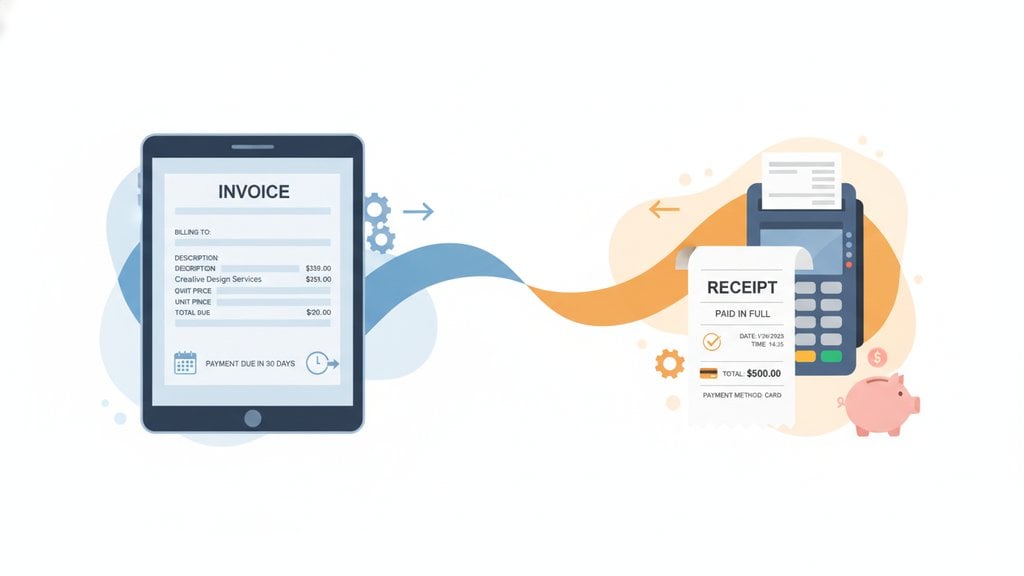
An invoice and a receipt are both documents that relate to a sale, but they serve completely different purposes at different points in a transaction. An invoice is a request for payment sent before money changes hands, while a receipt is proof that payment was already made. Mixing them up can cause real problems with bookkeeping, tax deductible receipt claims, and invoice compliance audits.
Content Table
What Is an Invoice
An invoice is a formal billing document sent by a seller to a buyer. It lists the goods or services provided, the amounts owed, payment terms (like "Net 30"), and where to send payment. It does not confirm that money has been received. Think of it as a politely worded demand: "Here is what I did, here is what you owe me, please pay by this date."
Invoices are used almost exclusively in business-to-business (B2B) transactions and in service work where payment comes after delivery. A freelance designer sends an invoice after completing a logo. A wholesaler sends an invoice when shipping a pallet of goods. A consultant sends an invoice at the end of the month.
For invoice compliance purposes, most jurisdictions require invoices to carry specific fields: the seller's tax ID, a unique invoice number, the date, and a breakdown of line items with applicable tax rates. The exact requirements vary by country, but the core structure is consistent. You can review a detailed breakdown in our guide to invoice requirements if you need to check what applies to your situation.
What Is a Receipt
A receipt is a confirmation that payment was received. It comes after the money moves. The receipt definition is essentially an acknowledgment: "We got your payment, here is what it was for." Receipts are common in retail (a paper slip from a cash register), online shopping (an email confirmation), and service businesses that collect payment upfront.
A retail receipt typically shows the items purchased, the price, any taxes collected, the total paid, the payment method, and the date and time. Receipts do not usually include payment terms or due dates because payment has already happened.
Receipts matter enormously for receipt accounting. Businesses use them to record expenses, reconcile bank statements, and support expense reimbursement claims. Individuals need them to prove purchases for warranty claims, returns, and tax deductible receipt claims on business expenses.
Invoice vs Receipt: Side-by-Side Comparison
| Feature | Invoice | Receipt |
|---|---|---|
| Timing | Before or at the time of requesting payment | After payment is received |
| Purpose | Request payment | Confirm payment was made |
| Who issues it | The seller | The seller |
| Who uses it most | B2B transactions, freelancers, service providers | Retail, e-commerce, any paid transaction |
| Payment status | Unpaid (outstanding) | Paid (settled) |
| Includes payment terms | Yes (due date, late fees) | No |
| Unique document number | Required (for compliance) | Often included, not always required |
| Tax implications | Creates a tax liability record | Supports expense deduction claims |
| Common format | Formal document (PDF, e-invoice) | Paper slip, email, PDF |
When to Use Each One
Use an invoice when:
- You are billing a business client after completing a project or delivering goods
- Payment is expected within a set number of days (Net 15, Net 30, etc.)
- You need a paper trail for accounts receivable
- The buyer needs a document to process payment through their accounting system
- You are required to report VAT or sales tax on the transaction
Use a receipt when:
- A customer pays you on the spot (cash, card, or digital payment)
- You collect a deposit upfront before starting work
- A buyer needs proof of purchase for a warranty or return
- An employee needs documentation to get reimbursed for a business expense
- You are running a retail or e-commerce operation
A common scenario where both documents appear in sequence: a marketing agency sends an invoice to a client on the 1st of the month. The client pays on the 15th. The agency then issues a receipt (or marks the invoice "paid") confirming the payment. Both documents live in the records of both parties.
What Each Document Must Contain
Invoice requirements
Receipt requirements are generally lighter than invoice requirements because invoices carry more legal and tax weight. A well-formed invoice typically needs:
- A unique, sequential invoice number
- Invoice date and payment due date
- Seller's full name, address, and tax ID (VAT number where applicable)
- Buyer's full name and address
- A clear description of goods or services with quantities and unit prices
- Subtotal, applicable tax rates and amounts, and total due
- Payment instructions (bank details, accepted methods)
If you want to dig deeper into structuring the line items correctly, our article on how to write clear invoice line items covers exactly that.
Receipt requirements
Receipts are less standardized, but a solid receipt should include:
- Seller's name and contact information
- Date of payment
- Description of what was purchased
- Amount paid (broken down by item if multiple)
- Tax collected (required in most jurisdictions for VAT/GST compliance)
- Payment method (cash, card, transfer)
- A receipt or transaction number for reference
For digital transactions, most payment processors generate receipts automatically. For in-person service businesses, you may need to create them manually or use a simple tool.
Tax and Accounting Implications
This is where the invoice vs receipt distinction really matters for your finances.
Invoices are the primary record for income recognition. If you are on an accrual accounting basis, revenue is recognized when the invoice is issued, not when cash arrives. This affects when you owe tax. Invoices also support VAT/GST reporting: you declare output tax on invoices you issue, and input tax on invoices you receive from suppliers.
Receipts are the primary record for expense claims. To deduct a business expense from your taxable income, tax authorities typically require a receipt as proof. A bank statement alone is often not enough. The IRS guidance on record-keeping for small businesses explicitly states that documentary evidence (receipts, invoices, bills) is required for most expense deductions.
How long you need to keep both types of documents also varies by country. The general rule in most jurisdictions is three to seven years, but specific rules apply depending on the type of transaction and your business structure. Our guide on how long you should keep invoices covers the specifics by region.
Paperless invoicing and digital receipts are now legally accepted in most countries, provided they meet the same content requirements as paper versions and can be reliably retrieved during an audit. The EU VAT invoicing rules explicitly treat electronic invoices as equivalent to paper ones when authenticity and integrity are guaranteed.
Can One Document Serve as Both
Yes, in some situations. A "paid invoice" is the most common example. When you mark an invoice as paid (adding a payment date, amount received, and payment method), it functions as both a billing record and a receipt. Many accounting tools do this automatically when a payment is logged against an invoice.
This approach works well for B2B transactions where both parties want a single document in their records. It is less common in retail, where a separate receipt is issued at the point of sale and no prior invoice existed.
If you want to streamline the whole process from creating the invoice through to marking it paid, tools that support invoice automation can handle the status updates and send payment confirmations automatically, cutting out a lot of manual back-and-forth.

Make sure your invoices meet every legal requirement
Knowing the invoice vs receipt difference is step one. Step two is making sure your invoices actually contain every field required by law. Check the full invoice requirements guide to see exactly what your invoices need to be compliant.
Check Invoice Requirements →
Sometimes, but it depends on the context. For warranty claims or returns, most retailers require a receipt because it confirms payment was made. An invoice only shows that payment was requested. A paid invoice (one that shows the payment date and amount received) is generally accepted as proof of purchase in B2B contexts and for tax deduction purposes, but check with the specific organization or tax authority you are dealing with.
In most cases, marking your invoice as paid is sufficient. When a client pays, you update the invoice status to paid and note the payment date and method. That paid invoice acts as both the billing record and the payment confirmation. Some clients may specifically request a separate receipt document, especially larger companies with strict accounts payable processes, so it is worth asking upfront what format they need.
Yes, in virtually all major jurisdictions. The IRS, HMRC, and EU tax authorities all accept digital receipts and paperless invoicing as valid records, provided the document contains the required information (seller details, date, amount, description, tax) and can be reliably retrieved if requested during an audit. The key is keeping the files organized and backed up, not just leaving them buried in an email inbox.
You may still be able to claim the deduction, but it becomes harder to defend in an audit. Alternatives include a bank or credit card statement showing the transaction, a vendor-issued duplicate receipt (many businesses can reprint these), or a written explanation of the expense with supporting context. Tax authorities vary on how strictly they apply the receipt requirement for smaller amounts, but for significant expenses, always try to obtain a replacement document.
A proforma invoice is a preliminary document sent before a sale is finalized. It looks like a regular invoice but is not a payment demand and does not create a legal obligation to pay. It is used to give buyers a price estimate, help with customs declarations, or get internal purchase approval. It sits earlier in the process than a regular invoice, and much earlier than a receipt. Think of the sequence as: proforma invoice, then invoice, then receipt.
The standard range is three to seven years depending on your country and business type. In the US, the IRS generally recommends keeping records for at least three years from the date you filed the return they relate to, and up to seven years for certain situations like bad debt claims. In the EU, VAT records typically need to be kept for five to ten years. When in doubt, keep records longer rather than shorter, since the cost of storage is far lower than the cost of a failed audit.