


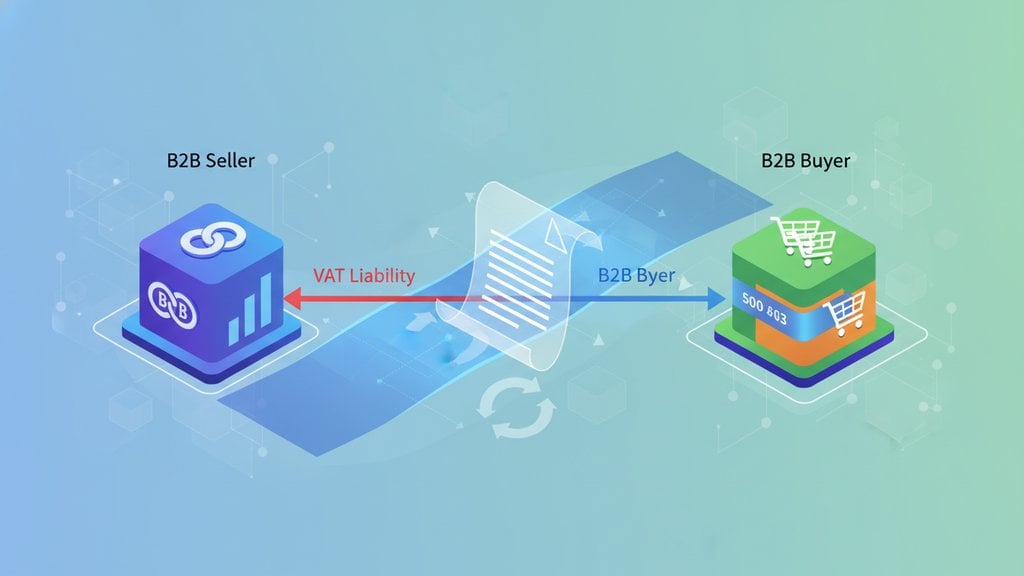
A reverse charge invoice shifts the VAT liability from the seller to the buyer, meaning the seller issues the invoice without charging VAT, and the buyer accounts for it instead. This mechanism is standard practice in cross-border B2B transactions, particularly within the EU, and getting the invoice format wrong can trigger penalties or rejected tax filings. Here is exactly what you need on that invoice and why it works the way it does.
Content Table
- What Is the Reverse Charge Mechanism
- When Does Reverse Charge Apply
- Mandatory Fields on a Reverse Charge Invoice
- The Reverse Charge Statement: Wording That Holds Up
- Intra-EU Transactions: Extra Requirements
- What the Buyer Must Do After Receiving the Invoice
- Common Mistakes That Get Invoices Rejected
- Country-by-Country Differences to Watch
What Is the Reverse Charge Mechanism
Under normal VAT rules, a seller charges VAT to the buyer, collects it, and remits it to the tax authority. The reverse charge mechanism flips that. The seller issues the invoice with zero VAT, and the buyer self-assesses the VAT in their own country. The buyer both reports and (if eligible) reclaims the same VAT in a single accounting entry, which is why the cash impact is often neutral for fully taxable businesses.
The EU introduced this approach primarily to prevent VAT fraud on cross-border supplies, where a seller in one member state could collect VAT and then disappear before remitting it. By making the buyer responsible, the liability stays local and traceable.
When Does Reverse Charge Apply
The reverse charge mechanism applies in several distinct situations:
- Intra-EU B2B services: When a VAT-registered business in one EU member state provides services to a VAT-registered business in another, the EU VAT Directive's general rule places the supply where the customer is established, triggering reverse charge.
- Intra-EU goods (intra-community supplies): The seller zero-rates the goods; the buyer accounts for acquisition VAT in their country.
- Domestic reverse charge: Several EU countries apply it domestically for high-risk sectors like construction, mobile phones, and carbon credits. Germany, the UK (post-Brexit), France, and the Netherlands all have sector-specific domestic rules.
- Imports from outside the EU: Some countries apply reverse charge at the point of import rather than requiring the importer to pay VAT at the border.
- Non-EU cross-border B2B: Countries like Australia (GST), Canada (GST/HST), and the UK have their own equivalents for certain imported services.
The common thread is always the same: both parties must be VAT-registered businesses, and the buyer must be able to self-assess in their jurisdiction. Consumer sales (B2C) almost never qualify.
Mandatory Fields on a Reverse Charge Invoice
A reverse charge invoice must include everything a standard VAT invoice requires, plus a few extras. Missing any of these can cause the buyer's tax authority to reject the self-assessment or deny input tax recovery.
| Field | What to Include | Notes |
|---|---|---|
| Invoice date | The date the invoice is issued | Determines the tax period for the buyer's self-assessment |
| Sequential invoice number | Unique, unbroken numbering series | Required in all EU member states and most other jurisdictions |
| Seller's full name and address | Legal trading name and registered address | Must match VAT registration records |
| Seller's VAT number | Country prefix + number (e.g. DE123456789) | Buyer needs this to verify the seller is VAT-registered |
| Buyer's full name and address | Legal name and registered address | Must be the business entity, not an individual |
| Buyer's VAT number | Country prefix + number | Mandatory for intra-EU transactions; omitting it is a common audit trigger |
| Description of goods or services | Clear, specific description | Vague descriptions like "consulting" alone can be challenged |
| Net amount (excluding VAT) | Total value before tax | This is what the buyer uses to calculate the self-assessed VAT |
| VAT rate and amount | Show 0% VAT with zero amount | Do not leave the VAT field blank; explicitly state 0% |
| Reverse charge statement | Explicit wording that reverse charge applies | See the next section for exact wording options |
| Legal reference (EU invoices) | Article 194 or 196 of EU VAT Directive 2006/112/EC | Technically required under EU rules; many tax authorities expect it |
For well-structured invoice line items that hold up under audit, the description field matters more than most sellers realise. Each line should specify what was delivered, the quantity, unit price, and the period it covers if it is a recurring service. You can find practical guidance on writing clear invoice line items in our invoice line items guide.
The Reverse Charge Statement: Wording That Holds Up
The statement is not optional. EU VAT Directive Article 226(11a) requires that invoices subject to reverse charge include a reference to the applicable provision or the words "reverse charge." In practice, most tax authorities accept a combination of both.
Accepted formulations include:
- "VAT reverse charge applies - Article 196 of Council Directive 2006/112/EC"
- "Reverse charge - the recipient is liable for the VAT"
- "Tax liability transfers to the recipient (§13b UStG)" (Germany-specific domestic reference)
- "Autoliquidation de la TVA" (France, for domestic reverse charge)
- "Inversión del sujeto pasivo" (Spain)
For intra-EU B2B services, the VAT Directive Article 196 reverse charge services invoice requirements apply, so Article 196 is the correct reference to quote. For intra-community supplies of goods, Article 138 governs the seller's zero-rating, while the buyer accounts for acquisition VAT under Article 200. When in doubt, cite both the directive article and a plain-language description.
Intra-EU Transactions: Extra Requirements
Cross-border B2B transactions within the EU carry a few additional obligations beyond the invoice itself.
EC Sales List (ESL): Sellers providing intra-EU services subject to reverse charge must report those supplies on a periodic EC Sales List (also called a recapitulative statement). In most member states this is monthly or quarterly. The buyer's VAT number is required for this report, which is another reason it must appear on the invoice.
VIES validation: Before issuing a reverse charge invoice to an EU customer, verify their VAT number through the EU's VIES system. If the number is invalid and you issue a reverse charge invoice, you may be liable for the VAT yourself. Our VAT number checker lets you validate EU VAT numbers directly.
Supply of goods vs. services: The rules differ. For goods, you also need proof of transport across the border (CMR documents, freight invoices, customs declarations) to justify the zero-rating. For services, the invoice and the customer's VAT registration are typically sufficient.
As EU member states roll out mandatory e-invoicing, the format requirements for reverse charge invoices are also evolving. Check the EU e-invoicing mandates overview to see which countries already require structured electronic formats and what that means for your reverse charge invoices.
What the Buyer Must Do After Receiving the Invoice
Understanding the buyer's side helps sellers issue invoices that actually work. When a VAT-registered business receives a valid reverse charge invoice, it must:
- Calculate the VAT due at the applicable local rate (not the seller's country rate).
- Record the VAT as both output tax (as if they charged it to themselves) and input tax (as a deductible purchase) in the same VAT return period.
- Report the supply in the relevant box of the VAT return. In the UK, this is boxes 1 and 4; in Germany, it goes in Zeile 48/49 of the Umsatzsteuervoranmeldung.
- For intra-EU goods, also report the acquisition on the Intrastat declaration if the threshold is exceeded.
If the buyer is not fully taxable (for example, a partially exempt business or a public body), the reverse charge still applies but they cannot reclaim all of the input VAT. This is entirely the buyer's problem to manage, but sellers should be aware that issuing an incorrect invoice can create disputes if the buyer's auditor later questions the basis for self-assessment.
Common Mistakes That Get Invoices Rejected
These are the errors that come up repeatedly in audits and VAT disputes:
- Missing the buyer's VAT number: Without it, the reverse charge cannot be verified. The invoice may be treated as a standard taxable supply, leaving the seller liable for VAT they did not collect.
- No reverse charge statement: Tax authorities in Germany, France, Spain, and the Netherlands have all issued penalties for omitting the required wording.
- Wrong legal reference: Citing Article 194 (domestic reverse charge) instead of Article 196 (intra-EU services) or vice versa signals that the seller does not understand the basis of the transaction.
- Charging VAT on top of the reverse charge statement: This creates a double-tax situation. The buyer will refuse to pay the VAT element and the invoice becomes contested.
- Issuing reverse charge invoices to non-VAT-registered customers: Reverse charge only works between VAT-registered businesses. If the customer is not registered, normal VAT rules apply.
- Using the wrong currency without an exchange rate: If you invoice in USD or GBP to a eurozone buyer, include the applicable exchange rate and its source so the buyer can calculate VAT in euros accurately.
Knowing the legal requirements for your specific country helps avoid most of these. Our country-specific invoice requirements guide lets you select a country and see exactly which fields are mandatory, common mistakes to avoid, and links to official legal sources.
Country-by-Country Differences to Watch
The EU VAT Directive sets the floor, but member states add their own rules on top. Here are the most significant variations:
| Country | Domestic Reverse Charge Sectors | Specific Wording Required | Key Local Rule |
|---|---|---|---|
| Germany | Construction, cleaning, scrap metal, mobile phones (above €5,000), greenhouse gas certificates | "Steuerschuldnerschaft des Leistungsempfängers" or reference to §13b UStG | Domestic reverse charge invoices must not show any VAT amount |
| France | Construction subcontracting, waste/recycling, mobile phones | "Autoliquidation" on the invoice face | The buyer reports on line CA3 of the French VAT return |
| Netherlands | Construction, cleaning, temporary staffing, gold | "BTW verlegd" (VAT shifted) | Requires a G-rekening (blocked account) system for construction chains |
| Spain | Construction, real estate sales by VAT-registered sellers, scrap metal | "Inversión del sujeto pasivo" | Both parties must retain evidence that the buyer is a taxable person |
| United Kingdom | Construction (CIS), mobile phones and computer chips (above £5,000), renewable energy certificates | "Reverse charge: VAT Act 1994 Section 55A applies" | Post-Brexit, intra-GB supplies follow UK VAT Act, not EU Directive |
| Italy | Construction, electronics, energy sector, greenhouse gas certificates | "Inversione contabile" or "Reverse charge ex art. 17 DPR 633/72" | Italy's mandatory e-invoicing (SDI system) applies to reverse charge invoices too |
Getting your invoicing process right from the start also affects how quickly you get paid. Clear, compliant invoices with the right payment terms reduce back-and-forth with buyers.

Check Exactly What Your Reverse Charge Invoice Needs
Our country-specific invoice requirements guide shows the mandatory fields, common mistakes, and official legal references for reverse charge invoices in Germany, France, Spain, the Netherlands, Italy, and more. Select your country and get a precise checklist in seconds.
Check Invoice Requirements →
No. On a reverse charge invoice, the seller charges 0% VAT and the total payable equals the net amount. You should still show a VAT line explicitly stating 0% rather than leaving it blank, and you must include the reverse charge statement. The buyer calculates and self-assesses the VAT at their local rate in their own VAT return.
The consequences depend on the country, but the most common outcome is that the invoice is treated as a standard taxable supply, making you liable for the VAT you did not charge. You may also face penalties for issuing a non-compliant invoice. In most cases you can issue a corrected invoice, but this creates delays and may trigger an audit enquiry. Issue a credit note against the original and reissue correctly as soon as you spot the error.
No. Reverse charge only applies between VAT-registered businesses. If your customer is a private individual, a small business below the registration threshold, or a non-taxable legal entity, you must charge VAT at the normal rate applicable in your country or, for digital services to EU consumers, apply the OSS rules. Always verify the customer's VAT registration before issuing a reverse charge invoice.
For intra-EU B2B services (the most common scenario), cite Article 196 of Council Directive 2006/112/EC. For intra-EU supplies of goods where the buyer is liable, Article 200 applies. For domestic reverse charge within a member state where the seller is not established there, Article 194 is the relevant provision. Using the wrong article does not always trigger a penalty, but it signals an error and can invite scrutiny.
Yes. When a business outside the EU (or in a different EU member state) sells digital services, software licences, SaaS subscriptions, or similar electronically supplied services to a VAT-registered EU business, the general B2B place-of-supply rule applies. The supply is taxable where the customer is established, and the customer accounts for VAT via reverse charge. The EU's OSS scheme applies only to B2C sales, not B2B reverse charge transactions.
A credit note issued against a reverse charge invoice must follow the same rules as the original. It should reference the original invoice number and date, show the net credit amount with 0% VAT, and include the reverse charge statement. The buyer then adjusts their self-assessed VAT accordingly in the period the credit note is received. Omitting the reverse charge reference on a credit note creates a mismatch in the buyer's VAT records.