

Invoice factoring is when you sell your unpaid invoices to a third-party company (a "factor") at a small discount, and they pay you most of the money right away instead of you waiting 30, 60, or 90 days for your customer to pay. You typically get 70% to 90% of the invoice value within a day or two, then the rest (minus a fee) once your customer settles up. It's a fast way to turn slow-paying accounts receivable into working cash you can use today.
For a business that's growing but cash-strapped, or one stuck waiting on big clients who pay late, factoring solves a very specific problem: the money is owed to you, but you can't spend a promise. Below is exactly how it works, what it costs, and when it makes sense.
Content Table
How Invoice Factoring Works Step by Step
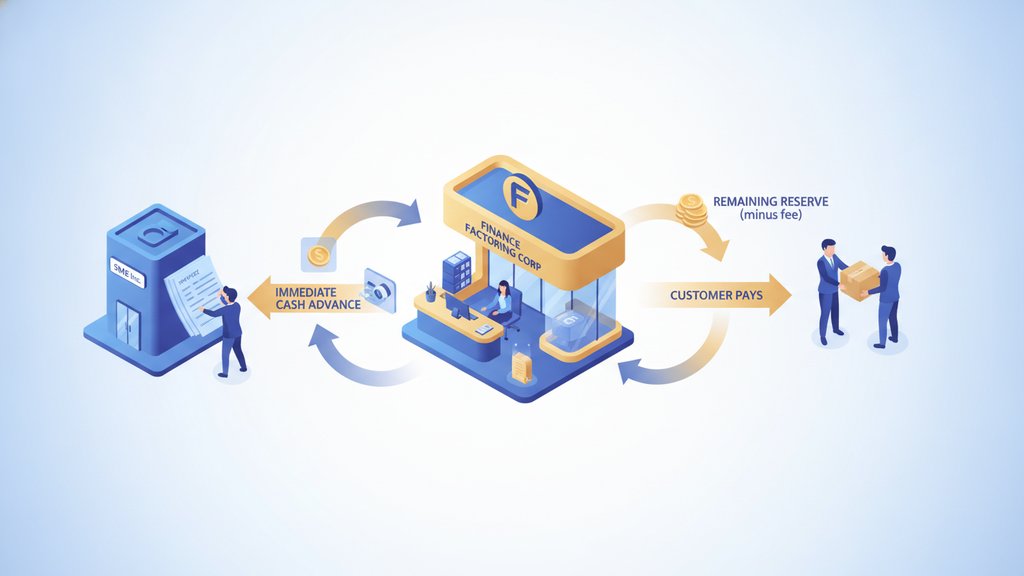
The mechanics are simpler than the jargon suggests. Here's the full cycle from invoice to cash:
- You deliver goods or services and send your customer an invoice with normal payment terms (say, net 30).
- You sell that invoice to a factoring company. They verify it's legitimate and that your customer is creditworthy.
- The factor advances you the bulk of the value, usually 80% to 90%, within 24 to 48 hours. This is your cash flow advance.
- Your customer pays the factor directly (not you) when the invoice is due. In most factoring arrangements, the customer knows the invoice was sold.
- The factor releases the remaining balance (the "reserve") to you, minus their fee.
Say you invoice a client $10,000 on net-60 terms. A factor advances you $8,500 (85%) tomorrow. Two months later your client pays the factor the full $10,000. The factor keeps a $300 fee (3%) and sends you the remaining $1,200. You got most of your money 58 days early for $300.
What Invoice Factoring Actually Costs
The main cost is the factoring fee (sometimes called the discount rate), which usually runs between 1% and 5% of the invoice value. The exact rate depends on:
- Your customers' credit: Factors care more about who owes the money than about your business. Blue-chip clients mean lower fees.
- How long invoices take to pay: A net-30 invoice costs less to factor than a net-90 one, because the factor's money is tied up longer.
- Volume: Higher monthly factoring volume usually earns better rates.
- Fee structure: Some factors charge a flat fee; others charge a rate that increases the longer the invoice stays unpaid (for example, 1% for every 30 days).
| Cost Element | Typical Range | What It Depends On |
|---|---|---|
| Advance rate | 70% to 90% | Industry and customer risk |
| Factoring fee | 1% to 5% | Volume, terms, customer credit |
| Time to funding | 24 to 48 hours | Verification speed |
Watch for extra charges some factors bury in contracts: setup fees, monthly minimums, wire transfer fees, and early-termination penalties. Always ask for the all-in effective annual cost before signing.
Recourse vs Non-Recourse Factoring
This is the single most important distinction to understand, because it decides who eats the loss if your customer never pays.
- Recourse factoring: If your customer fails to pay, you have to buy the invoice back or replace it with another one. It's cheaper because you carry the risk. Most factoring is recourse.
- Non-recourse factoring: The factor absorbs the loss if the customer goes bankrupt or can't pay. It costs more, and the "protection" often only covers specific situations like insolvency, not slow payment or disputes.
Invoice Discounting vs Factoring
People mix these up constantly. Both fall under the broader umbrella of invoice finance (also called accounts receivable financing), but they work differently in one big way: who collects the money.
| Feature | Invoice Factoring | Invoice Discounting |
|---|---|---|
| Who collects payment | The factor | You keep collecting |
| Customer awareness | Usually knows | Usually confidential |
| Credit control | Handled by factor | Stays with you |
| Best for | Smaller businesses wanting to outsource collections | Larger firms with solid credit systems |
With invoice discounting, you borrow against your receivables but your customers never know and you handle chasing payments yourself. With factoring, the factor takes over collections and your customer pays them directly. If keeping your client relationships private matters, discounting is the discreet option. If you'd rather offload the whole hassle of following up on past due invoices, factoring bundles that in.
Pros and Cons of Selling Invoices
Factoring is a tool, not a cure-all. Here's the honest balance sheet.
The upsides
- Fast cash: Money in a day or two instead of two months.
- No new debt on the books: You're selling an asset, not taking a loan.
- Approval based on your customers: Easier to qualify than a bank loan if your clients are solid but your own credit is thin.
- Scales with sales: The more you invoice, the more funding you can access.
- Outsourced collections: The factor chases payment so you don't have to.
The downsides
- It's more expensive than bank credit: That 3% per invoice can work out to a high effective annual rate.
- You lose some control: A factor contacting your customers can feel impersonal if handled poorly.
- Not every invoice qualifies: Factors avoid customers with weak credit or disputed invoices.
- Contracts can lock you in: Minimums and long terms can trap you into factoring more than you want.
Is Invoice Factoring Right for You?
Factoring tends to fit best when your cash is stuck in receivables and you have growth or payroll you can't delay. It's especially common in trucking, staffing, manufacturing, and wholesale, where big B2B clients routinely pay on 60 or 90 day terms.
It's a strong fit if:
- You invoice other businesses (B2B), not consumers.
- Your customers are creditworthy but slow.
- You need predictable cash flow to cover payroll, materials, or new orders.
- A bank has turned you down because your business is young.
It's probably the wrong tool if your margins are razor-thin (the fee could wipe out your profit), if you mostly sell to consumers, or if your late-payment problem is really a collections problem you could fix in-house. Understanding the difference between what you're owed and what you owe helps here; our guide on accounts payable vs accounts receivable breaks that down clearly. And before you factor anything, make sure your invoices are clean and professional, since factors reject sloppy or incomplete ones. Starting from solid invoice templates keeps your paperwork factor-ready and speeds up verification.
Create Factor-Ready Invoices in Minutes
Factoring companies reject unclear or incomplete invoices during verification. Generate clean, professional invoices with correct line items and terms so selling your invoices for immediate cash goes smoothly.
Create an invoice →
Frequently Asked Questions
Most factors advance the bulk of your invoice value, typically 70% to 90%, within 24 to 48 hours of approving the invoice. The remaining reserve, minus the fee, arrives once your customer pays the factor. First-time setups may take a few extra days for account verification.
Factoring generally does not report to your business credit the way a loan does, because you're selling an asset rather than borrowing. Factors focus on your customers' creditworthiness, not yours. However, recourse arrangements can create liabilities if a customer fails to pay and you must buy the invoice back.
With traditional factoring, yes, because your customer pays the factor directly and receives payment instructions from them. If you want to keep the arrangement private, invoice discounting is the confidential alternative where you continue collecting payment and clients never learn a third party is involved.
Yes. Spot factoring lets you sell a single invoice as a one-off, which is useful for occasional cash gaps. It usually carries higher fees than whole-ledger factoring, where you commit to factoring most or all of your invoices in exchange for lower rates and monthly minimums.
A loan gives you a lump sum you repay with interest over time, and approval hinges on your credit and financials. Factoring gives you cash tied to specific invoices, with approval based on your customers' credit. Factoring is faster and adds no debt, but it usually costs more per dollar than bank credit.