
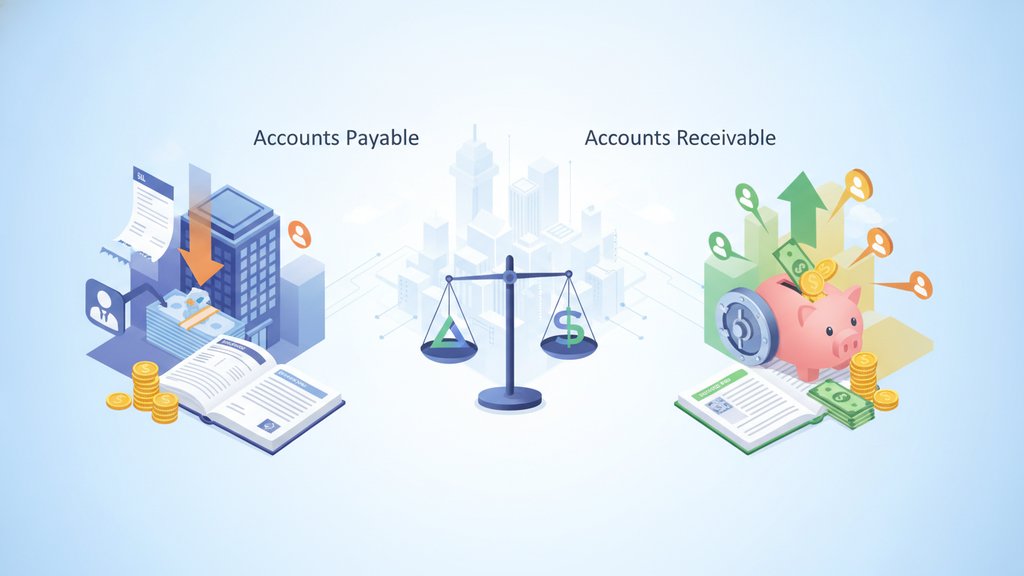
The simplest way to remember it: accounts payable is money your business owes, and accounts receivable is money owed to your business. Payable sits on your books as a liability (bills you need to pay to suppliers), while receivable is an asset (invoices your customers haven't paid yet). Understanding the difference between accounts receivable and payable is the backbone of healthy cash flow management, because one drains your bank account and the other feeds it.
Content Table
What Is Accounts Payable
Accounts payable (often shortened to AP) is the total of all the short-term debts your business owes to suppliers and vendors for goods or services you've already received but haven't paid for yet. When a supplier sends you a bill with 30-day terms, that amount lands in accounts payable until you settle it.
So what is account payable in practice? Say you run a bakery and buy $2,000 of flour on credit. The moment you accept that delivery and the invoice, you owe $2,000. That obligation is recorded as a liability on your balance sheet.
- It's a liability. It reduces what your business is worth until paid.
- It's short-term. Most AP is due within 30 to 90 days.
- You are the customer. Someone else invoiced you, and you owe them.
The paperwork behind AP is usually a supplier invoice or bill. If you've ever wondered whether those two words mean the same thing, the answer is nuanced, and we cover it in our breakdown of whether an invoice and a bill are actually different.
What Is Accounts Receivable
Accounts receivable (AR) is the mirror image: it's the money your customers owe you for products or services you've already delivered but haven't been paid for. When you send a customer an invoice with payment terms, that amount sits in accounts receivable until the cash arrives.
What is account receivable from your customer's perspective? It's their accounts payable. The same invoice is a receivable for the seller and a payable for the buyer, just recorded on opposite sides of two different sets of books.
- It's an asset. It's money you expect to collect.
- It's tied to invoices. Each unpaid invoice adds to your AR balance.
- You are the seller. You did the work and are waiting to get paid.
Because AR depends entirely on the invoices you issue, sending clean, correct documents matters. It also helps to know when to send an invoice versus other documents, like the difference between an estimate and an invoice and the gap between an invoice and a receipt.
Key Differences Side by Side
| Feature | Accounts Payable | Accounts Receivable |
|---|---|---|
| Direction of money | Money going out | Money coming in |
| Balance sheet type | Liability | Asset |
| Your role | Buyer / customer | Seller / vendor |
| Triggered by | Bills you receive | Invoices you send |
| Goal | Pay on time, not early | Collect as fast as possible |
| Effect on cash | Decreases cash when paid | Increases cash when collected |
How They Work Together in Real Life
Every credit transaction between two businesses creates both at once. Picture a printing company that prints menus for a restaurant:
- The printing company delivers the menus and sends a $1,500 invoice. That $1,500 becomes accounts receivable for the printer.
- The restaurant receives the same invoice and records $1,500 as accounts payable.
- When the restaurant pays 30 days later, the printer's AR drops by $1,500 and its cash rises. The restaurant's AP drops by $1,500 and its cash falls.
This is why bookkeeping is called double-entry: one economic event shows up in two places. In accounting terms, AP and AR are governed by the accrual method, where you record revenue and expenses when they're earned or incurred, not when cash changes hands. You can read more about how accrual accounting works.
Why They Matter for Cash Flow
You can be profitable on paper and still run out of money. That happens when your receivables come in slower than your payables go out. Good cash flow management is largely about controlling the timing gap between the two.
Two metrics finance teams watch closely:
- Days Sales Outstanding (DSO): the average number of days it takes to collect on an invoice. Lower is better.
- Days Payable Outstanding (DPO): the average number of days you take to pay suppliers. Slightly higher can help, as long as you stay within agreed terms.
Setting the right due dates on your own invoices is one lever you fully control. Our guide to the best payment terms for small businesses walks through which terms speed up collection without scaring customers away.
Common Mistakes to Avoid
- Mixing up which side you're on. The same invoice is receivable for the seller and payable for the buyer. Always ask: did I send this, or did I receive it?
- Ignoring aging reports. An AR aging report shows which invoices are 30, 60, or 90+ days late. Chase the old ones before they turn into bad debt.
- Paying every bill the moment it lands. Paying too early gives up cash you could hold. Pay on the due date, not before, unless there's an early-payment discount worth taking.
- Treating AR as guaranteed cash. A receivable is only worth something if the customer actually pays. Some never will.
- No systematic invoicing. Late or inconsistent invoices push your DSO up and starve your cash. Send invoices the day the work is done.

Turn accounts receivable into cash faster
Clean invoices sent on time are the fastest way to shrink your accounts receivable. Create professional invoices in minutes so customers know exactly what to pay and when.
Generate an invoice →
Frequently Asked Questions
Accounts payable normally carries a credit balance because it's a liability. When you record a new bill, you credit accounts payable and debit an expense or asset account. When you pay the bill, you debit accounts payable and credit cash, reducing the liability.
Yes, but not on the same set of books. One invoice is accounts receivable for the seller who issued it and accounts payable for the buyer who received it. It's the identical amount recorded from two opposite viewpoints in two separate accounting systems.
Both matter, but AR usually needs more attention for small businesses. Uncollected receivables directly starve your cash. Managing AP is about timing payments smartly, while managing AR is about actually getting paid, which is the difference between surviving and running dry.
If a customer never pays, the receivable becomes bad debt. You eventually write it off, removing it from assets and recording it as an expense. This is why aging reports and consistent follow-up matter, so overdue invoices don't quietly turn into permanent losses.
An increase in receivables reduces cash flow because sales haven't been collected yet. An increase in payables improves cash flow because you're holding onto cash longer. Both appear in the operating activities section as working capital adjustments that reconcile profit to actual cash.