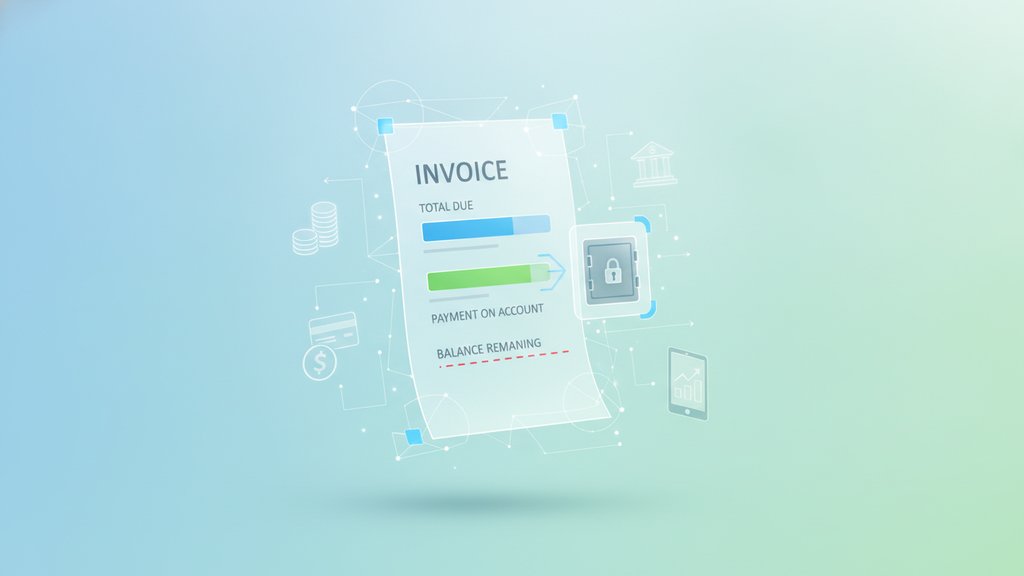
"Payment on account" on an invoice means money a customer has paid that hasn't been matched to a specific invoice yet, so it sits as a credit on their account until it's applied. You'll usually see the phrase when someone pays part of what they owe, sends money before an invoice is issued, or overpays and leaves a balance floating. In plain terms, it's cash received that is being held against the customer's overall balance rather than tied to one exact bill.
Content Table
What Payment on Account Actually Means
When a payment lands "on account," it goes toward the customer's total outstanding balance instead of clearing one particular invoice line by line. Think of it as a deposit into a running tab. The business knows the customer paid, but the money hasn't been officially connected to invoice #1042 or #1043 yet.
This matters because your books need to reflect two separate facts: cash arrived, and specific invoices are still marked as owed or paid. Payment on account bridges the gap while those two things get reconciled.
When You'll See It on an Invoice
The label pops up in a handful of everyday situations:
- Partial payments. A client owes $5,000 but sends $2,000 now. That $2,000 sits on account until the rest arrives or you assign it to specific invoices.
- Advance or prepayment. A customer pays before you've even issued the invoice, so there's no invoice number to attach it to yet. This is often called a prepayment invoice scenario.
- Overpayments. Someone pays $1,050 on a $1,000 bill. The extra $50 becomes an account credit for next time.
- Bulk payments. A regular client pays one lump sum covering several invoices without saying which is which. You hold it on account and split it later.
In each case the invoice or statement shows the amount "on account" so both sides can see money changed hands even though it isn't fully allocated.
How Payment on Account Works Step by Step
- Money comes in. The customer sends a payment that doesn't cleanly match a single open invoice.
- You log it as on account. The amount is recorded against the customer's balance as an unallocated credit.
- You allocate later. When the matching invoice is confirmed (or the customer tells you where to apply it), you attach the payment to that invoice.
- The balance updates. The invoice moves from "unpaid" to "paid" (or "partially paid"), and the on-account credit shrinks or disappears.
This flow is the heart of invoice reconciliation: matching real cash to real invoices so nothing gets double-counted or lost.
Payment on Account vs Similar Terms
A few phrases sound alike but mean different things. Here's how they line up:
| Term | What It Means | Tied to an Invoice? |
|---|---|---|
| Payment on account | Cash received, held as credit, not yet allocated | Not yet |
| Partial payment | Part of one invoice's total is paid | Yes, one specific invoice |
| Prepayment / advance | Money paid before goods or the invoice exist | No, invoice comes later |
| Account credit | A balance the customer can draw against | No, applies to future bills |
The overlap is real: a partial payment often lands on account first, then gets allocated. If you want the mechanics of splitting one bill across several payments, our guide to how split invoicing works breaks that down in detail. And because on-account money affects both what you're owed and what you owe, it helps to understand the wider picture of accounts payable versus receivable.
How to Record Payment on Account
In accounting terms, receiving money on account increases your cash and creates a liability or reduces a receivable, depending on the setup. A simple double-entry version looks like this:
- Debit: Cash / Bank (money you actually received)
- Credit: Customer account / Deferred income (the amount you now hold on their behalf)
Until you allocate it, that credit shows the customer has paid but the specific invoice hasn't been settled. Once you match it, you move the credit against the invoice and the receivable clears. Good accounting software handles this automatically when you mark a payment as "on account" and later "apply" it.
Common Mistakes to Avoid
- Leaving credits unallocated forever. Old on-account balances clutter your books and confuse customers. Clear them on a regular schedule.
- Mixing up prepayments and revenue. A prepayment isn't earned income until you deliver. Recognizing it too early inflates your numbers.
- Not noting it on the statement. Customers should see their on-account credit clearly, or they'll assume the payment vanished.
- Ignoring VAT timing. In many countries, tax can become due when you receive an advance, not when you invoice. Check your local rules.
Clear payment terms up front prevent most of these headaches. If you're setting expectations with clients, our overview of the best payment terms for small businesses 2026 covers deposits, deadlines, and how to word them. For the tax-treatment side, the EU's official VAT guidance explains when tax falls due on advance payments, and the UK's HMRC VAT invoice rules spell out what an invoice must show.
Track payments on account without the spreadsheet mess
Our free invoice generator lets you create clean invoices and note partial payments or payment on account so both you and your client always see the real balance.
Create an invoice free →
They're closely related but not identical. A deposit is usually an agreed advance for a specific job, while payment on account is any money held as an unallocated credit. A deposit often ends up sitting on account until you issue the final invoice and apply it.
Not immediately. Cash received on account is a credit against the customer's balance, not earned revenue. You only recognize it as income once you've delivered the goods or service and allocated the payment to a real invoice, keeping your accounts accurate.
Allocate it to one or more open invoices. Match the credit to the invoices the customer intended it for, mark those invoices paid or partially paid, and the on-account balance reduces accordingly. Do this regularly so credits don't pile up unnoticed.
A partial payment is applied to one specific invoice, reducing its balance. Payment on account is money not yet tied to any invoice. A partial payment sometimes starts as an on-account credit before you allocate it to the exact invoice it belongs to.
Yes. Always show on-account credits clearly on statements and invoices so customers can see their money was received. Hiding it leads to confusion, duplicate payments, and disputes. A visible credit line reassures clients and makes reconciliation smoother for everyone.